Key takeaways
- True lay-flat travel: Look for infinite-position three-motor designs rather than two-position recline. A chair that stops at 150° is fine for napping; one that opens to roughly horizontal lets you side-sleep without your hips carrying the load all night.
- Surface finish and glare: Woven fabric scatters light and stays visually quiet under a warm bulb. Faux leather reflects, which means a lamp behind your shoulder can throw a bright band across the headrest right where your eyes land. If you’re set on leather, plan for indirect light only.
- Power headrest range: An independently adjustable headrest lets you tilt away from a window or a fixture instead of rearranging the room. It’s the single most useful control for sleeping, and it doubles as glare management.
- Seat width against your footprint: A 26″ wide seat is genuinely roomy but it also pushes the chair further into the walkway, which affects where you can put a floor lamp without a cord crossing traffic. Measure the reclined depth, not the upright depth.
- Onboard power and ports: USB and Type-C ports on the chair mean your phone, a small clip light, or a sleep-sound device runs without a side table. Fewer surfaces means fewer lamps, which usually means a calmer room at 11pm.
What's inside
A recliner you sleep in every night lives a different life than one you sit in for a movie. It becomes furniture that has to hold a body for seven or eight hours without pressure points, and it usually sits in a corner of a bedroom or living room where the light is doing something you never planned for. That’s the part buyers underestimate. The chair goes flat, the body settles, and then the ceiling fixture is directly in your sightline, or the reading lamp that worked beside a sofa now glares off a faux-leather headrest at exactly the wrong angle. Sleep quality in a recliner is half mechanics, half ambience.
This guide looks at lay-flat and infinite-position lift recliners through both lenses: how well the frame supports overnight rest, and how the chair behaves in a room you’re trying to keep dim, warm, and restful. Fabric versus faux leather changes how a room reflects lamplight. Headrest travel changes where a sconce needs to sit. Cup holders and USB ports decide whether you need a side table with its own lamp at all. Below are six models worth considering for 2026, with notes on placement and light as well as build.
As an Amazon Associate we earn from qualifying purchases.



How to Choose a/an Recliner Chair For Sleeping (2026)
- True lay-flat travel: Look for infinite-position three-motor designs rather than two-position recline. A chair that stops at 150° is fine for napping; one that opens to roughly horizontal lets you side-sleep without your hips carrying the load all night.
- Surface finish and glare: Woven fabric scatters light and stays visually quiet under a warm bulb. Faux leather reflects, which means a lamp behind your shoulder can throw a bright band across the headrest right where your eyes land. If you’re set on leather, plan for indirect light only.
- Power headrest range: An independently adjustable headrest lets you tilt away from a window or a fixture instead of rearranging the room. It’s the single most useful control for sleeping, and it doubles as glare management.
- Seat width against your footprint: A 26″ wide seat is genuinely roomy but it also pushes the chair further into the walkway, which affects where you can put a floor lamp without a cord crossing traffic. Measure the reclined depth, not the upright depth.
- Onboard power and ports: USB and Type-C ports on the chair mean your phone, a small clip light, or a sleep-sound device runs without a side table. Fewer surfaces means fewer lamps, which usually means a calmer room at 11pm.
The Best Recliner Chair For Sleeping (2026)s Reviewed
MCombo 3 Motor Lay Flat Lift Recliner R7635
The three-motor infinite-position layout plus a power headrest makes this the most genuinely sleepable chair here, and the beige faux leather reads warm under a 2700K bulb rather than yellow. Keep your light source low and to the side, since the finish will bounce anything overhead straight back at you.
MCombo Power Lift Recliner R7399 (Large-Wide)
At 150° this is a reclining chair you can nap in rather than a bed substitute, but the fabric upholstery is the most forgiving surface in this lineup for a dim room, and the 26″ seat with a 4.7″ extra footrest suits taller sleepers. A solid pick if the chair sits under a ceiling fixture you can’t move.
MCombo 3 Motor Small Lift Recliner 7631
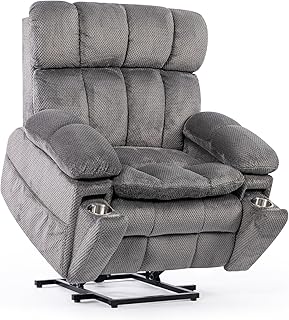
Built for petite frames, and the grey fabric is close to a neutral grey card, so it won’t tint the ambient light in a small bedroom. Infinite position and a power headrest in a compact shell means it can tuck beside a nightstand lamp without crowding the shade.
MCombo Triple Motor Lift Recliner 7661 (Navy)
Navy fabric absorbs a lot of light, which makes this the quietest-looking option after dark but also the one that needs the most deliberate lamp placement if you read before sleep. The triple-motor lay-flat mechanism and adjustable headrest are the same strong platform as the larger models, in a medium footprint.
Dual Motor 26″ Extra Wide Lift Chair with Flip Arm Storage
The zero-gravity position and flip-arm storage make this the most practical overnight chair for anyone who wants everything within reach and nothing on a side table. Type-C alongside USB is a small detail that removes one more adapter and one more glowing indicator light from the room.
Frequently Asked Questions
Is sleeping in a recliner every night safe?
Many people sleep in recliners long-term for reflux, sleep apnea, COPD, or post-surgical recovery, and clinicians often recommend it. The main risks are circulation-related, so an infinite-position chair that lets you change posture is preferable to one locked at a single angle.
Fabric or faux leather for a bedroom?
Fabric, in most cases. It runs cooler against skin over a full night and it diffuses lamplight instead of reflecting it, which keeps a small room from developing hot spots. Faux leather wipes clean more easily, which matters more in a caregiving context.
How much clearance does a lay-flat recliner need?
Assume the chair grows 12 to 18 inches deeper when fully open, plus wall clearance for the backrest on non-hugger models. Sketch the reclined footprint before deciding where a floor lamp or cord will go.
Do the massage and heat functions help with sleep?
Heat is the more useful of the two for settling in, particularly for lower-back stiffness. Massage motors are better as a wind-down before sleep than during it, since most units run on timers and the vibration can be rousing.
Final Thoughts
For most overnight sleepers, the MCombo R7635 is the strongest all-round choice thanks to true infinite positioning and a power headrest that solves both posture and glare. Smaller rooms and smaller frames are better served by the 7631, and if you want maximum width with everything stowed in the arms, the dual-motor 26″ extra-wide lift chair is the one to look at. Whichever you pick, place your light low, warm, and off to one side, and the chair will do the rest.