Key takeaways
- Reflectance under warm light: Pale species like white oak and fresh teak bounce roughly twice the light of dark tropical hardwoods. If you are working with two or three low-wattage fixtures, light wood does half your lighting job for free.
- Grain relief and shadow texture: Open, ribbon-like grain catches raking light and gives furniture visual depth at dusk. Tight, uniform grain looks cleaner but goes flat once the sun drops below fence height.
- Patina trajectory: Teak silvers, eucalyptus mellows toward honey, acacia deepens toward chocolate. Decide whether you want your palette to cool or warm over time, because the wood will commit either way.
- Oil content and moisture defense: Natural oils in teak, eucalyptus, and padauk resist rot without film finishes. Film finishes gloss up and create hotspot glare under downlights, so oiled wood generally photographs and reads better at night.
- Mass versus movement: Heavier hardwoods stay put in wind, which matters if you are aiming light at fixed seating positions. Light frames drift and leave your carefully aimed fixtures pointing at nothing.
What's inside
Most patio furniture gets chosen in a showroom under flat fluorescent light, then lives its whole life under something else entirely: low golden sun at 6pm, a strand of 2700K bulbs strung between two posts, the blue wash of moonlight at midnight. That mismatch is why so many decks feel oddly lifeless after dark. The wood you picked looked warm indoors and reads gray and flat outside, or it drinks up every lumen from your string lights and leaves the seating area feeling like a cave.
Wood species is a lighting decision as much as a durability one. Grain depth controls how shadows fall across a seat back. Surface reflectance decides whether your fixtures need to work hard or barely at all. And tannin-rich hardwoods shift hue over their first two seasons, which means the color relationship you build today will not be the one you have in 2028. This guide covers the species worth building an evening space around, what each one does under warm and cool light, and how to match seating to the ambience you actually want.
As an Amazon Associate we earn from qualifying purchases.


How to Choose a Wood For Patio Furniture (2026)
- Reflectance under warm light: Pale species like white oak and fresh teak bounce roughly twice the light of dark tropical hardwoods. If you are working with two or three low-wattage fixtures, light wood does half your lighting job for free.
- Grain relief and shadow texture: Open, ribbon-like grain catches raking light and gives furniture visual depth at dusk. Tight, uniform grain looks cleaner but goes flat once the sun drops below fence height.
- Patina trajectory: Teak silvers, eucalyptus mellows toward honey, acacia deepens toward chocolate. Decide whether you want your palette to cool or warm over time, because the wood will commit either way.
- Oil content and moisture defense: Natural oils in teak, eucalyptus, and padauk resist rot without film finishes. Film finishes gloss up and create hotspot glare under downlights, so oiled wood generally photographs and reads better at night.
- Mass versus movement: Heavier hardwoods stay put in wind, which matters if you are aiming light at fixed seating positions. Light frames drift and leave your carefully aimed fixtures pointing at nothing.
The Best Wood For Patio Furniture (2026)s Reviewed
Ashley Clare View Eucalyptus Outdoor Sofa
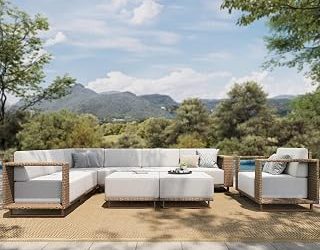
Eucalyptus sits in the ideal middle of the reflectance range, and the five-step weather-shielded finish here keeps that mid-honey tone stable instead of letting it gray out unevenly. The deep three-person frame and Nuvella cushions give you a broad low mass to graze with a single wall sconce or a pair of ground-level uplights, which is the most flattering setup available on a small deck.
Cambridge Casual Vermont 3-Piece Teak Conversation Set
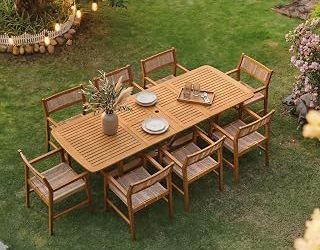
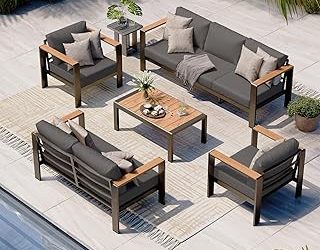
Natural-finish teak is the most forgiving species under warm LED, holding an amber note rather than shifting green the way some stained hardwoods do. Two armchairs plus a side table gives you a genuine conversation triangle, and the table surface is the natural home for a rechargeable lantern that anchors the whole scene.
Padauk Lumber Board, 3/4″ x 4″
Padauk is the accent species: a deep orange-red that reads almost violet under cooler light and turns molten under 2200K. Two boards at 36 inches is exactly enough for a custom side table top or a slatted lantern shelf where you want one saturated color note against paler seating.
Premium Lumber S4S 1/2″ x 6″ x 4′
Sustainably plantation-grown and surfaced on all four sides, this stock is the practical choice for building light-integrated pieces, think a slatted screen that throws striped shadow, or a bench with a channel routed for a low-voltage strip. The half-inch thickness is thin enough to glow slightly at the edges when backlit.
Cambridge Casual Maine 4-Foot Weathered Teak Bench
The weathered finish arrives already silvered, so you skip the awkward two-year transition where new teak clashes with everything around it. Silver teak is quietly the best canvas for colored light, taking on the hue of whatever you point at it without fighting back.
Frequently Asked Questions
Which wood works best with warm string lights?
Teak and eucalyptus. Both hold a golden undertone that harmonizes with 2200 to 2700K bulbs instead of turning muddy the way heavily gray-stained softwoods do.
Does dark wood really need more lighting?
Yes, meaningfully. Dark tropical hardwoods absorb most of the light that hits them, so plan on either more fixtures or pale cushions and a light-toned rug to reclaim the bounce.
Should I seal patio furniture with a glossy finish?
Not if evening ambience matters. Gloss creates specular hotspots under any point-source fixture. A penetrating oil protects just as well and scatters light softly.
How do I keep a mixed-species patio from looking chaotic?
Let one species carry the seating and use the second only in small accent pieces. A single saturated tone in a tabletop or shelf reads as intentional; two competing seating tones do not.
Final Thoughts
For most patios, the Cambridge Casual Vermont teak set is the safest foundation, since natural teak flatters nearly every light temperature and ages gracefully. Choose the Ashley Clare View eucalyptus sofa if you want maximum bounce from minimal fixtures, and add the weathered teak Maine bench when you want a surface that takes on the color of your lighting rather than dictating it.