Key takeaways
- Air delivery over headline PSI: Peak pressure sells units, but sustained CFM at 90 PSI is what actually keeps a framing or roofing nailer cycling. For pneumatic tools, look for roughly 4 CFM; for tires, seats, and inflatables, PSI alone is fine.
- Light quality, not light quantity: A wide, slightly diffused LED that spills across the valve stem beats a narrow spotlight that blinds you the moment you look up. Test whether the beam sits low enough to graze the work rather than bounce back off chrome.
- Display legibility at odd angles: You will read the gauge crouched, sideways, or upside down. Backlit digital readouts with tall numerals win; small mono-LCDs and analog dials both disappear under 50 lux.
- Acoustic footprint: Oil-free pancake tanks are convenient but loud, and low-frequency drone travels through floors in a way that ruins an evening’s mood. If you work in a finished space, favor lower-decibel models or plan for short bursts.
- Battery ecosystem or self-contained: If you already own a 20V or 18V platform, a bare tool is the cheapest way in. If you want something that lives in a car trunk with no charger nearby, choose a unit with its own large-capacity cell.
What's inside
Most of my work happens after the sun goes down. I light dining rooms, retail vignettes, and the occasional theatre set, which means the assembly and rigging that supports all of it gets done in half-dark rooms with a single clamp lamp for company. That is where I learned an unglamorous truth: an air compressor is a lighting problem as much as a power problem. If the gauge glows too hot, your pupils lock onto it and you lose the rest of the room. If the housing throws a hard-edged shadow across your work surface, you stop trusting your own hands. And if the motor drones at the wrong pitch, the whole atmosphere of a late build turns brittle.
So this guide reads a little differently from the usual spec sheets. I still care about PSI, CFM, and duty cycle, because a brad nailer that stalls mid-run wastes an evening. But I also judge how a unit behaves in low light: whether its LED reads as a usable wash or a glare source, whether the digital display stays legible at an angle, how much noise it adds to a quiet house, and whether it can be stashed under a console table without becoming furniture in its own right. Below are the portable compressors and inflators I would keep in a working studio in 2026.
As an Amazon Associate we earn from qualifying purchases.



How to Choose a Portable Air Compressor For Tools (2026)
- Air delivery over headline PSI: Peak pressure sells units, but sustained CFM at 90 PSI is what actually keeps a framing or roofing nailer cycling. For pneumatic tools, look for roughly 4 CFM; for tires, seats, and inflatables, PSI alone is fine.
- Light quality, not light quantity: A wide, slightly diffused LED that spills across the valve stem beats a narrow spotlight that blinds you the moment you look up. Test whether the beam sits low enough to graze the work rather than bounce back off chrome.
- Display legibility at odd angles: You will read the gauge crouched, sideways, or upside down. Backlit digital readouts with tall numerals win; small mono-LCDs and analog dials both disappear under 50 lux.
- Acoustic footprint: Oil-free pancake tanks are convenient but loud, and low-frequency drone travels through floors in a way that ruins an evening’s mood. If you work in a finished space, favor lower-decibel models or plan for short bursts.
- Battery ecosystem or self-contained: If you already own a 20V or 18V platform, a bare tool is the cheapest way in. If you want something that lives in a car trunk with no charger nearby, choose a unit with its own large-capacity cell.
The Best Portable Air Compressor For Tools (2026)s Reviewed
DEWALT DCC020IB 20V MAX Tire Inflator
The most composed inflator here in low light: the LED sits high enough to wash a wheel well evenly instead of punching a hot spot into it, and automatic shut-off means you can walk away and keep your eyes on other work. It runs on battery, corded AC, or 12V, which makes it the rare tool that is equally at home in a garage and a loading dock.
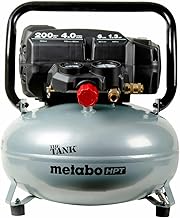
Metabo HPT EC914S 6-Gallon Pancake Compressor
This is the one you buy when you are actually driving nails. Six gallons at 200 PSI with roughly 4 CFM will run multiple framing, siding, or brad nailers at once, so a two-person trim day never stalls waiting on recovery. It is unapologetically loud, so I schedule tank runs before quiet hours and let the pressure carry me through the rest of the night.
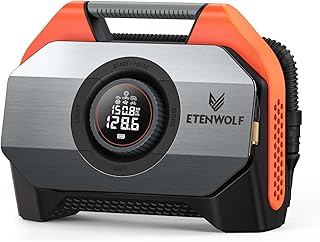
ETENWOLF VORTEX S6 Cordless Inflator
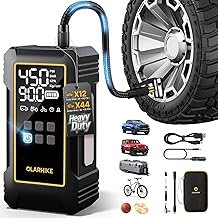
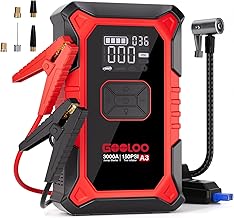
The dual-cylinder design and 100% duty cycle mean it will fill a truck tire without needing a rest, and the 19200mAh pack removes the battery-platform question entirely. Its LED backlight is bright and cool-toned, which reads beautifully on a dark shoulder but can feel clinical indoors.
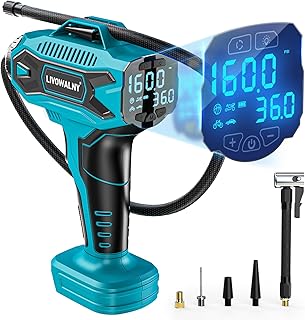
Makita 18V-Compatible 160 PSI Inflator
A sensible bare tool for anyone already invested in Makita 18V, with a digital gauge that holds its reading clearly and enough pressure headroom for motorcycles and sport balls alongside car tires. Expect solid function rather than refined light output.
DIYtoolifz 150 PSI Dewalt 20V-Compatible Inflator
The value pick if you have spare DEWALT packs sitting idle. The digital gauge and onboard LED cover the essentials competently, and at this pressure ceiling it is best understood as a tire-and-toy inflator rather than a tool-driving compressor.
Frequently Asked Questions
Can an inflator run a nail gun?
No. Inflators produce high pressure at very low volume, while nailers need sustained airflow from a tank. If you are fastening anything, you need a tanked compressor like the Metabo HPT.
How much noise should I expect indoors?
Cordless inflators are roughly conversational for short bursts. Pancake compressors are considerably louder and transmit low-frequency sound through floors, so treat them as a daytime tool in shared buildings.
Do I need automatic shut-off?
It matters most in poor light, when misreading a gauge by a few PSI is easy. Preset-and-walk-away also frees your attention for the actual work.
Are bare tools worth it?
Yes, if you already own two or more compatible batteries. If not, a self-contained unit like the VORTEX S6 usually costs less overall.
Final Thoughts
For pneumatic tool work, the Metabo HPT EC914S is the only real answer here, and its air delivery justifies the noise. For everything else, I reach for the DEWALT DCC020IB because its light and shut-off behavior respect the room you are working in, with the ETENWOLF VORTEX S6 as the better choice if you want no batteries to manage and no charger to find.