Key takeaways
- Flame loop and layering: Cheap units repeat a short animation you’ll catch within thirty seconds. Look for models with separate ember-bed and flame layers moving at different rates — the mismatch is what reads as unpredictable, and unpredictability is what reads as fire.
- Brightness floor, not ceiling: Every insert looks decent at full brightness. The useful measurement is the lowest setting: can it produce a faint evening glow without a visible flicker step? Multi-stage brightness with five or more levels gives you real control over a dim room.
- Color temperature and surround match: Amber and orange flames warm up wood, brick, and cream paint. Blue and violet modes suit cool grey stone or matte black surrounds but drain color from warm timber. Pick your flame palette after you know your trim material.
- Heat-off operation: Confirm the flames run independently of the heating element. Without this, your fireplace becomes seasonal decor and you lose two-thirds of its value.
- Glass depth and reflection: Recessed glass with an interior mesh or mirrored back builds visual depth, so flames appear to sit behind the opening rather than painted onto it. Flat-fronted panels tend to catch room reflections and flatten the effect.
What's inside
Most fireplace inserts get judged on heat output, which is the wrong first question. An insert spends maybe four months a year producing warmth and twelve months producing light. That light lands on your floorboards, your paint, the faces of people sitting nearby — and if the color temperature is off or the flame loop is too regular, the whole corner of the room reads as artificial. Buyers notice something feels wrong long before they can name it, and by then the box is unpacked and the surround is trimmed out.
This guide evaluates six inserts the way a lighting designer would assess any fixture: flame realism and loop length, how the glow interacts with surrounding surfaces, dimming range at low output, and whether the unit can run cold so it works as ambience in July. Heater performance still matters and is covered, but flame quality drives the ranking.
As an Amazon Associate we earn from qualifying purchases.


How to Choose a/an Insert Electric Fireplace (2026)
- Flame loop and layering: Cheap units repeat a short animation you’ll catch within thirty seconds. Look for models with separate ember-bed and flame layers moving at different rates — the mismatch is what reads as unpredictable, and unpredictability is what reads as fire.
- Brightness floor, not ceiling: Every insert looks decent at full brightness. The useful measurement is the lowest setting: can it produce a faint evening glow without a visible flicker step? Multi-stage brightness with five or more levels gives you real control over a dim room.
- Color temperature and surround match: Amber and orange flames warm up wood, brick, and cream paint. Blue and violet modes suit cool grey stone or matte black surrounds but drain color from warm timber. Pick your flame palette after you know your trim material.
- Heat-off operation: Confirm the flames run independently of the heating element. Without this, your fireplace becomes seasonal decor and you lose two-thirds of its value.
- Glass depth and reflection: Recessed glass with an interior mesh or mirrored back builds visual depth, so flames appear to sit behind the opening rather than painted onto it. Flat-fronted panels tend to catch room reflections and flatten the effect.
The Best Insert Electric Fireplace (2026)s Reviewed
PuraFlame Western 33″ Insert
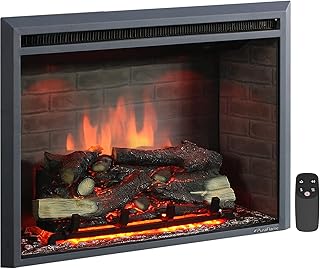
The Western’s strength is its ember bed, which holds a low sustained orange that keeps working after you dial the flames down — the closest thing here to genuine banked coals. Crackling audio is subtle enough to layer under conversation rather than compete with it, and the remote makes late-evening dimming adjustments practical from across the room.
PuraFlame Klaus 33″ Insert
The glass door and mesh screen combination is what separates the Klaus from its sibling: the mesh diffuses flame edges slightly, softening the hard outline that gives most electric units away at close range. Best suited to traditional masonry openings where the visible hardware reads as period-appropriate rather than decorative.
Westinghouse 50″ Recessed Fireplace
At 50 inches this is a light source before it’s a heater, throwing a wide low-level wash that genuinely changes how a room feels at night. Color-changing flames plus Alexa and Google Home control mean you can automate a warm amber at dusk and shift cooler later, and the 24-hour timer handles the rest without you touching a thing.
PuraFlame 27″ Free Standing Log Set
Six flame colors across five brightness levels gives this log set the widest tuning range in the group, which matters when you’re dropping it into an existing firebox with unknown wall color behind it. The freestanding format also means no cutting, no framing, and no commitment — useful in rentals or while you’re still deciding on a surround.
36″ Recessed Wall-Mounted Insert
The low-noise fan is the standout here, and it matters more than spec sheets suggest: audible fan hum undermines the calm a fireplace is meant to create. Clean modern framing and a slim recessed profile make it the natural pick for contemporary rooms where visible hardware would break the line.
Frequently Asked Questions
Can I run the flames without any heat?
Yes, on all six units here. This is the single most important feature for year-round use and the reason electric inserts have overtaken gel and ethanol alternatives for ambience-driven buyers.
How much room will 1500W actually heat?
Plan on roughly 400 square feet of supplemental warmth in a reasonably insulated room. Treat electric inserts as zone heaters that make one seating area comfortable, not as central heating replacements.
Do I need an electrician?
Freestanding log sets plug into a standard outlet. Recessed and wall-mounted models often benefit from a dedicated 15-amp circuit, since 1500W on a shared circuit can trip breakers when other loads join in.
Will the flame effect look fake in daylight?
Somewhat, yes — ambient daylight overwhelms any internal light source. Recessed models with deeper glass hold up best, and daytime performance improves noticeably if the insert sits away from direct window light.
Final Thoughts
For traditional openings where flame depth matters most, the PuraFlame Klaus earns the top spot on the strength of its mesh-diffused flame edge. The Westinghouse 50″ is the choice for anyone treating the fireplace as primary evening lighting, with smart-home scheduling that makes the glow automatic. And the PuraFlame 27″ log set remains the smartest low-commitment entry point, offering the widest color tuning of anything here without touching your existing masonry.