Key takeaways
- Flow before pressure: GPM carries residue away; PSI only loosens it. A 2.0 GPM machine rinses faster and leaves fewer drying spots than a high-PSI, low-flow unit, which matters enormously when you are chasing sunlight before it goes flat.
- Power source and site access: Electric models need a reliable 120V outlet and stay quiet enough for early-morning residential work. Gas frees you from cords entirely, which is the right answer for fleet lots, job sites, and clients without accessible power.
- Foam capability: An onboard soap tank or a solid foam cannon fitting gives you dwell time, so chemistry does the lifting instead of pressure. Thick, even foam also makes it easy to see coverage gaps under a work light.
- Weight and handling: If you lift it in and out of a van daily, every pound compounds. Look at frame design, wheel size, and whether the hose and wand store without tangling.
- Nozzle set and control: Quick-connect tips let you drop from a 25-degree rinse to a wide 40-degree fan in seconds. Anything narrower than 15 degrees should stay off painted panels entirely.
What's inside
Anyone who has spent years aiming light at surfaces knows a hard truth that detailers learn the hard way: illumination is an honest critic. Park a car under a 5000K LED panel and every missed panel gap, every dried soap streak, every ghost of a spiral scratch steps forward like it was waiting for its cue. Mobile detailers work in exactly this environment — driveways at dusk, parking decks lit by sodium fixtures, garages with a single strip light overhead — and the pressure washer is the tool that decides whether the reveal looks intentional or apologetic. Too little flow and film clings to the clearcoat, catching light in a dull haze. Too much pressure held too close and you carve a texture into trim that no amount of wax will hide.
This guide looks at pressure washers through that lens: not just raw PSI on a box, but how consistently a machine rinses a surface so it reads clean under scrutiny. We compare electric and gas platforms, sort out what flow rate actually does for foam and rinse work, and note which units are genuinely portable enough to load and unload a dozen times a day. Whether you are polishing a client’s SUV or resetting a set of teak patio chairs before a shoot, the picks below cover the realistic range of mobile setups.
As an Amazon Associate we earn from qualifying purchases.


How to Choose a Pressure Washer For Mobile Detailing (2026)
- Flow before pressure: GPM carries residue away; PSI only loosens it. A 2.0 GPM machine rinses faster and leaves fewer drying spots than a high-PSI, low-flow unit, which matters enormously when you are chasing sunlight before it goes flat.
- Power source and site access: Electric models need a reliable 120V outlet and stay quiet enough for early-morning residential work. Gas frees you from cords entirely, which is the right answer for fleet lots, job sites, and clients without accessible power.
- Foam capability: An onboard soap tank or a solid foam cannon fitting gives you dwell time, so chemistry does the lifting instead of pressure. Thick, even foam also makes it easy to see coverage gaps under a work light.
- Weight and handling: If you lift it in and out of a van daily, every pound compounds. Look at frame design, wheel size, and whether the hose and wand store without tangling.
- Nozzle set and control: Quick-connect tips let you drop from a 25-degree rinse to a wide 40-degree fan in seconds. Anything narrower than 15 degrees should stay off painted panels entirely.
The Best Pressure Washer For Mobile Detailing (2026)s Reviewed
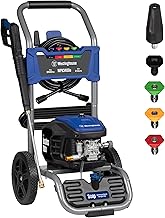
Westinghouse WPX3400e Electric
A brushless motor paired with 2.0 GPM makes this the most balanced electric option here — enough flow to sheet water cleanly off a hood, quiet enough for 7 a.m. driveway work. The onboard soap tank and five-nozzle set mean you can move from pre-soak to final rinse without swapping hardware.
Westinghouse WPX3400 Gas
At 2.6 GPM, this is the volume king of the group, and that extra flow shows in how quickly it clears road film from wheel wells and lower rockers. Choose it when you work off-grid or on commercial lots, and stay disciplined with nozzle distance since the output is unforgiving on soft trim.
Sun Joe SPX3000
The dual detergent tanks are the quiet standout, letting you keep wheel cleaner and body soap loaded at once. It is a modest performer on flow, but for a detailer building out a first mobile kit on a tight budget, it delivers dependable results on paint and patio stone alike.
Active 2.0 Electric
Purpose-built for detailing rather than adapted to it, this unit trades peak PSI for a steady 2.0 GPM — the trade every experienced detailer eventually makes. Foam consistency is excellent, and the compact footprint slides behind a van seat without a fight.
CRAFTSMAN CMEPW1700
The lightest, gentlest option in the lineup at 1700 PSI, which makes it a smart pick for delicate work: convertible tops, vinyl wraps, powder-coated outdoor furniture. It will not strip a concrete pad quickly, but it will never surprise you with damage either.
Frequently Asked Questions
How much PSI does mobile detailing actually need?
Between 1500 and 2200 PSI at the nozzle handles nearly all vehicle work. Higher-rated machines are useful for concrete and fencing, but you should throttle them back or step up to a wider tip on paint.
Electric or gas for a mobile setup?
Electric wins on noise, maintenance, and residential goodwill. Gas wins on flow and independence from outlets. Many detailers eventually run both and choose per job.
Can I use these on outdoor furniture?
Yes, with care. Use a 40-degree tip, hold 18 inches back, and test on an underside first — teak, wicker, and powder coat all respond differently, and raised grain is permanent.
Do I need a separate foam cannon?
An onboard tank is convenient for rinse-friendly soaps, but a dedicated cannon produces denser foam and longer dwell. If you do paint decontamination regularly, buy the cannon.
Final Thoughts
For most mobile detailers, the Westinghouse WPX3400e is the sensible center of gravity — real flow, quiet operation, and enough versatility to move from a client’s sedan to their patio set in the same visit. Step up to the gas WPX3400 if you frequently work without power access, or choose the Active 2.0 if detailing is your sole focus and you want a machine tuned for foam and finish rather than brute force.