Key takeaways
- Flow over force: GPM does the lifting; PSI only does the pushing. For paint, glass, and finished wood, a machine near 2.0 GPM rinses contaminants away instead of grinding them across the clear coat, which is exactly what creates those fine swirls that catch every light source in the driveway.
- Foam that actually clings: A cannon needs enough volume to lay down thick, slow-sliding suds with real dwell time. Thin foam runs off in seconds and does nothing for the chemical decontamination stage.
- Nozzle range with a wide option: A 40-degree fan and an adjustable soap tip matter far more than the 0-degree pencil jet, which has no business near furniture or bodywork. Quick-connect fittings save you from mid-wash improvising.
- Hose length and coil discipline: Reach determines whether you circle the vehicle or drag the unit behind you. Retractable or wall-mounted storage keeps the hose off the floor and away from grit that later gets dragged across your finish.
- Noise, weight, and where it lives: Brushless motors run quieter and cooler for long detailing sessions. If the machine is heavy or awkward, it stays in the corner — and unused equipment cleans nothing.
What's inside
Spend enough years aiming light at surfaces for a living and you develop a slightly unhealthy relationship with clean. Raking light — a low, hard beam skimming across a finish at a shallow angle — is the most honest critic in any room or driveway. It exposes the haze on a lacquered sideboard, the chalky bloom on powder-coated patio chairs, the dried mineral freckles on a hood you swore you’d rinsed properly. Buyers get frustrated because they’re chasing a look, not a spec, and no amount of raw pressure fixes a surface that was scoured instead of lifted.
This guide approaches pressure washers the way I approach a lighting plan: what does the finish need to reflect properly, and what’s the gentlest way to get there? Below are six machines that handle automotive detailing and the harder-working side of home furnishings — teak benches, aluminum frames, resin wicker, stone tabletops — with notes on flow rate, foam behavior, nozzle control, and the storage realities of a garage that also has to fit a car in it.
As an Amazon Associate we earn from qualifying purchases.


How to Choose a Pressure Washer For Detailing (2026)
- Flow over force: GPM does the lifting; PSI only does the pushing. For paint, glass, and finished wood, a machine near 2.0 GPM rinses contaminants away instead of grinding them across the clear coat, which is exactly what creates those fine swirls that catch every light source in the driveway.
- Foam that actually clings: A cannon needs enough volume to lay down thick, slow-sliding suds with real dwell time. Thin foam runs off in seconds and does nothing for the chemical decontamination stage.
- Nozzle range with a wide option: A 40-degree fan and an adjustable soap tip matter far more than the 0-degree pencil jet, which has no business near furniture or bodywork. Quick-connect fittings save you from mid-wash improvising.
- Hose length and coil discipline: Reach determines whether you circle the vehicle or drag the unit behind you. Retractable or wall-mounted storage keeps the hose off the floor and away from grit that later gets dragged across your finish.
- Noise, weight, and where it lives: Brushless motors run quieter and cooler for long detailing sessions. If the machine is heavy or awkward, it stays in the corner — and unused equipment cleans nothing.
The Best Pressure Washer For Detailing (2026)s Reviewed
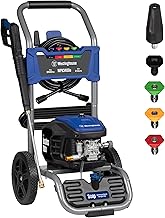
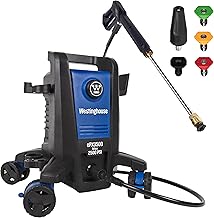
Westinghouse WPX3400e
The 2.0 GPM flow paired with a brushless motor makes this the most capable all-rounder here — enough volume for genuine rinse-off on a full vehicle, then enough reach to strip winter film from a stone patio table. The onboard soap tank is convenient, though serious detailers will still prefer a dedicated cannon for pre-wash.
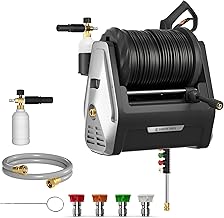
Giraffe Tools Wall Mounted Essential 100FT
Mounting the unit on the wall and letting 100 feet of hose auto-rewind solves the problem nobody mentions in reviews: hose management is what makes people skip a proper wash. At 2900 PSI and 2.2 GPM it has plenty of authority, so lean on the wide tips when you’re working near finished surfaces.
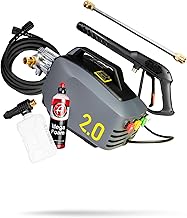
Adam’s Polishes Active Pressure Washer 2.0
Built by people who think about paint first — 1800 PSI and 2.0 GPM is a deliberately detailing-friendly ratio, and the bundled Mega Foam gives you a working chemistry setup on day one. It’s the pick if your priority is a flawless, glare-free finish rather than blasting concrete.
Westinghouse ePX3500
The anti-tipping design and pro-style steel wand make this a genuinely pleasant machine to work with over an hour-long session. At 1.76 GPM it’s a touch lighter on flow, which suits delicate outdoor furniture and smaller vehicles better than a mud-caked truck.
Hiclean 2100 PSI
Compact, quiet, and easy to carry out to a balcony or shared driveway, this is the sensible entry point for apartment dwellers and occasional detailers. The turbo and fan nozzles cover most household jobs; just accept it’s a maintenance tool rather than a restoration one.
Frequently Asked Questions
How much pressure is safe on car paint and finished furniture?
Keep working pressure between roughly 1200 and 1900 PSI at the surface, use a 40-degree tip, and hold the wand 12 to 18 inches away. Distance and angle protect a finish more reliably than the number on the box.
Do I need a separate foam cannon if the unit has a soap tank?
For best results, yes. Onboard tanks dispense diluted soap at low pressure, which is fine for maintenance washes, but a cannon produces the clinging foam that loosens grit before any contact happens.
Can these machines clean teak and rattan safely?
Teak tolerates a wide fan at moderate pressure and low-angle passes with the grain. Natural rattan and painted wicker are far less forgiving — mist, brush, and rinse rather than pressure-wash.
Why do spots still appear after a careful wash?
Those are dissolved minerals left behind as water evaporates, not a cleaning failure. Work in shade, dry immediately with a blower or plush towel, and consider an inline filter if your water is hard.
Final Thoughts
If you want one machine to serve both the car and the outdoor furniture, the Westinghouse WPX3400e offers the best balance of flow, refinement, and long-session comfort. Detail-focused buyers should look at the Adam’s Active Pressure Washer 2.0 for its paint-safe ratio and ready-made foam setup, while anyone tired of wrestling hose coils will find the wall-mounted Giraffe Tools Essential 100FT quietly transforms how often the job actually gets done.