Best Heat Lamp Thermostat for Brooders, Reptile Tanks, and Greenhouses
Find the best heat lamp thermostat for brooders, reptile tanks, and greenhouses. Compare on/off, dual-outlet, and day-night controllers before you buy.
A heat lamp without a thermostat is a guess. It runs at full power until someone notices the brooder is too hot or the basking spot has cooled off, and by then chicks can be stressed, reptiles can be sluggish, or seedlings can be scorched. The best heat lamp thermostat takes that guesswork away. It reads the temperature through a sensor probe, switches the lamp on and off or dims it smoothly, and holds the space near the temperature you set, hour after hour, without constant attention.
That matters in every setting where a heat lamp does real work. In a chick brooder, a steady temperature in the first weeks of life supports healthy growth and reduces losses. In a reptile terrarium, a stable basking temperature supports digestion, activity, and shedding. In a greenhouse or incubation setup, a controller keeps warmth consistent through cold nights and warm afternoons. A good thermostat does not just add convenience. It protects the animals and plants that depend on the heat, and it protects the lamp itself from running harder than it needs to.
This guide explains how to choose a heat lamp thermostat, compares three controllers that suit heat lamps, and answers the questions buyers ask most often. Every pick below is a standalone thermostat controller designed to regulate heating equipment, including heat lamps. Before ordering, re-check the listing on Amazon, because availability and specifications can change after this article was written.
How to Choose a Heat Lamp Thermostat
Match the control type to the lamp
There are two main control styles, and the right one depends on the lamp. On/off controllers cut power when the probe reads above the set temperature and restore it when the temperature falls below it. They are simple, reliable, and well suited to ceramic heat emitters, which produce heat without light and do not mind cycling. They also work with standard incandescent heat bulbs, though the bulb will switch on and off through the day.
Dimming controllers, often called PID controllers, adjust the power going to the lamp gradually instead of switching it fully on or off. The light fades up and down as the controller holds the set temperature. This style suits visible basking bulbs, because it avoids the constant flicker of an on/off cycle and tends to extend bulb life. If the setup uses a halogen basking bulb or a deep heat projector, a dimming controller is usually the better choice.
Check the wattage ceiling
Every thermostat has a maximum load, usually stated in watts. Add up the wattage of everything plugged into it and stay comfortably below that ceiling. A single 100-watt or 150-watt heat lamp sits well within the limits of the controllers in this guide, but a setup with two lamps, or a lamp plus a heat mat, needs more headroom. Overloading a controller is a safety risk, so treat the wattage rating as a hard limit, not a suggestion.
Look at the temperature range
Most heat lamp thermostats cover a range around 40 to 108 degrees Fahrenheit, which suits brooders, reptile enclosures, and seed starting. Some controllers offer a much wider range, which can be useful for incubation or for setups that need a cooler night setting and a warmer day setting. Make sure the range includes the temperature the animals or plants actually need, with room on both sides so the controller is not working at its edge.
Consider day and night settings
Many animals need a warmer day and a cooler night. A controller with a day and night cycle lets you set two different temperatures on a 24-hour schedule, so the lamp eases down after dark without manual adjustment. This feature is especially useful in chick brooders, where the temperature is usually lowered gradually as the birds grow, and in reptile enclosures, where a night drop mirrors natural conditions.
Probe placement and alarms
The sensor probe is the thermostat’s eyes. It should sit where the heat matters most, near the basking spot or at chick height in a brooder, and not pressed against the lamp or buried under bedding. A probe with a long cord gives more freedom to place it well. Alarms add a layer of safety: an over-temperature alarm warns when the enclosure gets too hot, and a sensor fault alarm warns when the probe fails or disconnects. Both are worth having in any setup that runs unattended.
Safety certification and build
Look for a controller from an established brand with a safety listing, such as ETL or UL, and a sturdy housing. The controller will run for long periods, often in warm and humid conditions, so a flimsy unit is a poor investment. A clear digital display that shows both the current temperature and the set temperature makes daily checks quick, and simple push-button controls reduce the chance of an accidental change.
Top Picks
1. BN-LINK Digital Heat Mat Thermostat Controller — Best Overall
Top Pick
1. BN-LINK Digital Heat Mat Thermostat Controller — Best Overall
The BN-LINK controller is the most widely recommended heat lamp thermostat in its class, and it earns that position with a straightforward design that covers the common cases well. It is a plug-in on/off controller with a digital display, a sensor probe, and a control range of 40 to 108 degrees Fahrenheit. It handles heating devices up to 1000 watts, which covers a single heat lamp with plenty of headroom, and it carries an ETL listing.
Setup takes minutes. Plug the controller into a wall outlet, plug the heat lamp into the controller, place the probe where the heat matters, and set the target temperature with three buttons. The display switches between Fahrenheit and Celsius, and a hanging tab lets the unit mount on a wall or the side of a brooder. The listing states plainly that the controller works with heat lamps as well as heat mats, which is exactly what this guide is about.
The BN-LINK suits brooders, reptile tanks, greenhouses, and incubators. Its main limitation is the on/off control style: a visible bulb will cycle on and off, which some keepers find distracting, and the 108-degree upper limit rules out the hottest basking setups. For the great majority of heat lamp uses, though, this controller is the sensible default.
The VIVOSUN controller is a close rival to the BN-LINK, with the same 40 to 108 degree Fahrenheit control range and the same 1000-watt capacity. It is a plug-in on/off unit with a digital LCD display, three-button setup, a sensor probe, and a hanging tab for wall mounting. Its display range runs from 32 to 210 degrees Fahrenheit, so it can show temperatures well outside the range it controls.
What sets the VIVOSUN apart is its rugged, easy-grip hexagonal housing and its track record in both reptile keeping and seed starting. The listing reports strong recent sales, and the controller is sold directly by VIVOSUN with shipping from Amazon. It works with heat lamps, heat mats, and other heating equipment, and the three-button interface is as simple as the BN-LINK.
Like the BN-LINK, this is an on/off controller, so a visible bulb will cycle rather than dim. The probe is light and can detach easily if it is not secured, so take care with placement and route the cord so animals cannot tug it loose. For a keeper who wants a tough, simple controller with a wide display range, the VIVOSUN is a solid choice.
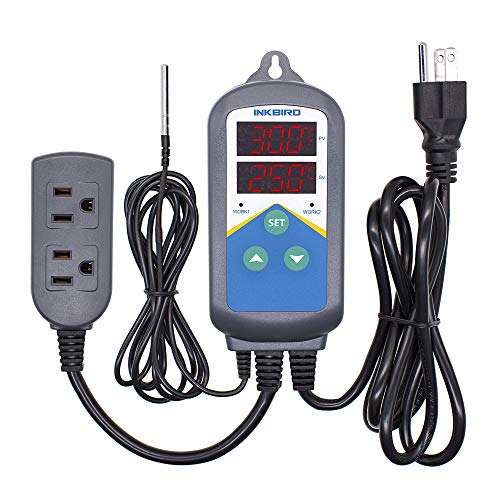
The Inkbird ITC-306T is the pick for setups that need more than a single set temperature. It is a heating-only controller with two outlets, both for heating devices, and a 24-hour day and night cycle that lets you set a different temperature for day and night. Its control range is exceptionally wide, from minus 58 to 210 degrees Fahrenheit, and it handles up to 1200 watts of heating equipment.
The dual display shows the measured temperature and the set temperature at the same time, and the unit includes temperature calibration, an over-temperature alarm, and a sensor fault alarm that switches the outputs off if the probe fails. The two outlets mean one controller can run two heat lamps, or a lamp and a heat mat, as long as the combined load stays within the 1200-watt limit. The day and night cycle is the standout feature: brooder keepers can schedule a cooler night temperature, and reptile keepers can mirror a natural daily rhythm without touching the dial.
The ITC-306T is an on/off controller, so it does not dim bulbs, and it is heating only, with no cooling output. Its wide range and extra features also make it slightly more complex to program than the simpler single-outlet units. For anyone running a brooder or terrarium that needs a scheduled temperature change, the extra setup effort pays off quickly.
Start with the lamp off and the controller unplugged. Mount the heat lamp securely above the brooder or enclosure, with a guard if animals can reach it, and keep it clear of bedding, wood, and other flammable material. Plug the controller into the wall outlet, then plug the lamp into the controller’s outlet.
Place the sensor probe at the level where the heat is needed, near the basking spot or at chick height, and secure it so it cannot slip or be dragged. Set the target temperature, then switch the system on and watch the display for a full cycle. The temperature should rise to the set point, the lamp should switch off or dim, and the temperature should drift down slightly before the lamp comes back on. Check the setup several times over the first day, and use a separate thermometer to confirm the probe reading, because a single sensor can mislead if it is badly placed.
Keep the controller itself out of direct spray and away from the hottest part of the enclosure. Check the probe and cords weekly for chewing, wear, or loose connections, and replace a damaged probe rather than working around it.
Common Mistakes to Avoid
The most common mistake is placing the probe in the wrong spot. A probe hanging in cool air makes the lamp run too long, and a probe touching the bulb makes it shut off too early. Put the probe where the animal actually rests.
The second mistake is ignoring the wattage limit. Two 250-watt lamps plus a heat mat can exceed a 1000-watt controller, so add the numbers before plugging anything in.
The third mistake is using an on/off controller with a bulb that should not cycle, such as a mercury vapor lamp, or using a dimming controller with a heat mat, which does not respond well to dimming. Match the control style to the heat source, as described above.
Finally, never run a heat lamp setup without a working thermostat and a backup thermometer. A thermostat is a safety device as well as a convenience, and an enclosure that overheats while nobody is watching is a real risk.
Frequently Asked Questions
Can I use a heat mat thermostat with a heat lamp?
Yes, in most cases. The controllers in this guide are marketed for heat mats, but their listings state that they also work with heat lamps and other heating devices, as long as the total load stays within the wattage limit. The key difference is the control style: an on/off controller suits ceramic heat emitters best, while a dimming controller suits visible basking bulbs.
Do I need a dimming thermostat or an on/off thermostat?
It depends on the bulb. Ceramic heat emitters and standard incandescent heat bulbs work well with on/off controllers. Halogen basking bulbs and deep heat projectors do better with a dimming controller, because steady dimming avoids flicker and extends bulb life. If the setup uses only a ceramic emitter, an on/off controller is the simpler and cheaper option.
What temperature should I set for a chick brooder?
Newly hatched chicks generally need a warm spot near 95 degrees Fahrenheit in the first week, with the temperature lowered by about 5 degrees each week as they feather out. The thermostat probe should sit at chick height under the lamp, and the brooder should also have a cooler area so chicks can move away from the heat. Always confirm with guidance for the specific breed, and watch the birds: chicks huddled tightly under the lamp are cold, and chicks spread far from it are hot.
What temperature should I set for a reptile basking spot?
It varies widely by species. A bearded dragon basking spot is often set near 100 to 110 degrees Fahrenheit, while a leopard gecko warm hide is usually nearer 88 to 92 degrees. Check the requirements for the species being kept, place the probe at the basking surface, and confirm the reading with a separate thermometer or an infrared temperature gun.
Can one thermostat control two heat lamps?
Yes, if the controller has two outlets and the combined wattage stays within its limit. The Inkbird ITC-306T in this guide has two heating outlets with a 1200-watt ceiling. A single-outlet controller can also run two lamps through a splitter, but the total load must stay under the controller’s rating, and both lamps will follow the same temperature setting.
Conclusion
The best heat lamp thermostat is the one matched to the lamp and the animals or plants it serves. For most setups, the BN-LINK controller is the best overall pick: simple, widely used, and explicitly rated for heat lamps. The VIVOSUN controller is a rugged alternative with the same capacity and range. The Inkbird ITC-306T is the right choice when the setup needs a day and night schedule or two heating outlets.
Whichever controller is chosen, the essentials stay the same. Place the probe where the heat matters, respect the wattage limit, match the control style to the bulb, and check the setup with a separate thermometer. A heat lamp thermostat is a small device, but it is the difference between a stable, safe enclosure and one that depends on luck.
Disclosure: As an Amazon Associate, we earn from qualifying purchases.
H
Home Beautiful Design Editorial Team
We compare specs, materials and verified owner reviews before a product earns a spot. Rankings are never paid.
Affiliate disclosure. As an Amazon Associate we earn from qualifying purchases at no extra cost to you. Prices accurate as of the date shown.
Discover the best reed diffuser for living rooms, bedrooms, and bathrooms. Compare five elegant, long-lasting reed diffusers for inviting home fragrance.