Key takeaways
- Sealed suction over headline numbers: Figures like 40Kpa or 55KPa describe peak pressure, not real-world pickup. A well-gasketed head that keeps its grip on smooth planks will out-clean a higher-rated machine that leaks air at the seams.
- Onboard lighting geometry: LED headlights only help if they sit low and throw forward at a shallow angle. That grazing wash is what makes fine dust and hair legible on dark or high-gloss floors, where overhead lighting flattens everything into invisibility.
- Anti-tangle brush design: Hair wrap is the number-one reason a stick vacuum stops performing. Look for tapered or comb-cut rollers, and soft-bristle or hybrid rollers that won’t leave micro-scratches on satin polyurethane.
- Honest runtime at usable power: A quoted 60 or 70 minutes is almost always eco mode. Estimate a third of that on max, then check whether the battery detaches for swapping or fast top-ups.
- Where it lives between uses: Self-standing bodies and wall docks keep the tool visible and charged, which is the single best predictor of whether you’ll actually use it. A vacuum in a closet is a vacuum you use monthly.
What's inside
Anyone who works with light for a living knows the cruelest test of a hard floor is not a white glove. It is a low, raking beam — late afternoon sun through a west window, or a wall-washer set close to the baseboard. At that grazing angle, every fiber, crumb, and paw-printed haze on your engineered oak stops hiding in the grain and starts casting its own tiny shadow. Homeowners who spend money on beautiful floors and beautiful fixtures often discover the two work against each other, and then blame the finish when the real culprit is the cleaning routine.
Hard floors also refuse to forgive the wrong tool. Dust doesn’t sink into them the way it does into carpet pile; it skates, drifts into the edges of the room, and gets flung around by stiff bristles or a poorly sealed nozzle. This guide looks at cordless vacuums specifically through that lens — suction that lifts fine grit rather than pushing it, brush rolls that glide instead of scratching, onboard lighting that shows you what your ceiling fixtures are hiding, and enough runtime to finish an open-plan floor in one pass. Below are the models worth your attention in 2026, followed by what actually matters when you compare them.
As an Amazon Associate we earn from qualifying purchases.


How to Choose a Cordless Vacuum For Hard Floors (2026)
- Sealed suction over headline numbers: Figures like 40Kpa or 55KPa describe peak pressure, not real-world pickup. A well-gasketed head that keeps its grip on smooth planks will out-clean a higher-rated machine that leaks air at the seams.
- Onboard lighting geometry: LED headlights only help if they sit low and throw forward at a shallow angle. That grazing wash is what makes fine dust and hair legible on dark or high-gloss floors, where overhead lighting flattens everything into invisibility.
- Anti-tangle brush design: Hair wrap is the number-one reason a stick vacuum stops performing. Look for tapered or comb-cut rollers, and soft-bristle or hybrid rollers that won’t leave micro-scratches on satin polyurethane.
- Honest runtime at usable power: A quoted 60 or 70 minutes is almost always eco mode. Estimate a third of that on max, then check whether the battery detaches for swapping or fast top-ups.
- Where it lives between uses: Self-standing bodies and wall docks keep the tool visible and charged, which is the single best predictor of whether you’ll actually use it. A vacuum in a closet is a vacuum you use monthly.
The Best Cordless Vacuum For Hard Floors (2026)s Reviewed
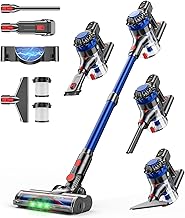
KARDV 500W / 40Kpa 8-in-1 Cordless Stick Vacuum
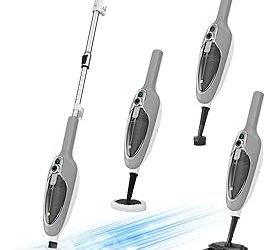
The most balanced all-rounder here: 500W of motor output is plenty for sealed hardwood and tile, and the eight-piece attachment set covers stair nosings, upholstery, and the dusty shadow line where skirting meets floor. The wall-mount dock is the quiet hero, keeping it charged and within arm’s reach of the rooms that need it.
650W / 55KPa Self-Standing Stick Vacuum with Touch Screen
This is the power option, and it shows on grouted tile and textured LVP where grit settles into the low points. The self-standing body means you can pause mid-room without leaning it against a wall, and the touch display gives you clear feedback on the mode you’re actually running rather than guessing by ear.
Shark VACMOP VM252 Cordless Vacuum & Spray Mop
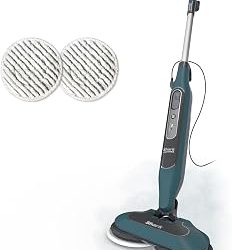
A specialist rather than a generalist, and genuinely excellent at what it does: vacuum and damp-mop in a single pass, which is the only way to remove the fine film that makes a glossy floor look dull under warm light. Disposable pads keep dirty water off the floor entirely, though ongoing pad cost is the trade-off.
Tikom V500 Cordless Stick Vacuum
Light in the hand and well-judged for smaller homes and apartments, with a wall dock and an LED touch screen that keeps setup fuss to a minimum. At 450W it is the gentlest of the group on delicate finishes while still clearing pet hair from open floors reliably.
650W / 55KPa OLED Self-Standing Stick Vacuum (Red)
Mechanically close to its sibling above, with a crisper OLED readout and a finish that earns its place on show if you’d rather not hide the thing. Worth choosing if you want top-tier suction and a machine that reads as an object rather than an appliance.
Frequently Asked Questions
Will a motorized brush roll scratch hardwood?
Not if the bristles are soft or the roller is a hybrid soft/stiff design, which describes most current stick vacuums. The real risk is trapped grit dragged under the head, so empty the bin and clear the roller regularly.
How much suction do hard floors actually need?
Less than carpet. Anything in the 40Kpa range clears hard surfaces comfortably; the extra headroom on 50–55Kpa models matters mainly for grout lines, entry mats, and embedded pet hair.
Is the advertised runtime realistic?
Treat it as an eco-mode ceiling. Plan on roughly 15–25 minutes at high power, which is enough for most single floors if you aren’t running max the whole time.
Do I still need a separate mop?
For most homes, yes — vacuuming removes debris but not the residue that dulls sheen. A combined unit like the VACMOP handles both, otherwise pair any stick vacuum with a flat microfiber mop.
Final Thoughts
For most homes, the KARDV 8-in-1 is the sensible default: enough power for hard floors, the accessory range to reach the corners your lighting exposes, and a dock that keeps it in circulation. Step up to the 650W / 55KPa self-standing model if you have tile, grout, or heavy pet traffic, and add the Shark VACMOP if what bothers you most is the dull film that shows up the moment the sun drops low across the room.