Key takeaways
- Fabric sheen and light behaviour: Matte woven fabrics diffuse lamplight softly and hide hotspots. Faux leather reflects it — beautiful next to a single warm source, unforgiving under a bright ceiling fixture. Decide which light your room actually has before you pick a finish.
- Reclined sightline: Sit back and note where your eyes land. A high-backed recliner tipped 40 degrees puts your gaze on the ceiling, so any uplight or exposed bulb becomes the view. Chairs that recline shallower keep your focus on the wall, which is where you want a TV or a picture light.
- Wall clearance for pushback mechanisms: Pushback designs need only a few inches behind them, so they can sit near a wall — critical if your reading lamp is plug-bound to a fixed outlet. Rockers need more room and will drift out of a lamp’s useful pool.
- Colour under warm bulbs: Beiges warm up and read creamier at 2700K; greys can go slightly green under cheap LEDs. If you light with warm white, cool-toned grey needs a high-CRI bulb nearby to stay true.
- Frame visibility in low light: Exposed wood legs and rivet trim catch highlights and keep a chair from turning into a dark mass after sundown. Fully upholstered bases disappear — restful in a bedroom, heavy in a small living room.
What's inside
A recliner is the only chair in the house that changes shape after dark. At 3pm it’s a reading seat catching window light; at 9pm it’s the piece your floor lamp has to negotiate with. Most buyers shop them like sofas — swatch, price, delivery date — and only discover the problem later, when the backrest tips into a pool of glare or the upholstery turns muddy under warm bulbs. Sheen, seat depth, and the angle of the headrest all decide how a room feels once the overheads go off.
This guide reads recliners the way a lighting designer would: how the fabric handles a 2700K bulb, whether the reclined sightline points into a lamp or away from it, how much visual weight the frame carries in a dim corner. Six current models are covered below, from heated wingbacks to slim pushbacks built for apartments, with notes on the ambience each one creates rather than just the specs on the box.
As an Amazon Associate we earn from qualifying purchases.


How to Choose a/an Recliner Armchairs (2026)
- Fabric sheen and light behaviour: Matte woven fabrics diffuse lamplight softly and hide hotspots. Faux leather reflects it — beautiful next to a single warm source, unforgiving under a bright ceiling fixture. Decide which light your room actually has before you pick a finish.
- Reclined sightline: Sit back and note where your eyes land. A high-backed recliner tipped 40 degrees puts your gaze on the ceiling, so any uplight or exposed bulb becomes the view. Chairs that recline shallower keep your focus on the wall, which is where you want a TV or a picture light.
- Wall clearance for pushback mechanisms: Pushback designs need only a few inches behind them, so they can sit near a wall — critical if your reading lamp is plug-bound to a fixed outlet. Rockers need more room and will drift out of a lamp’s useful pool.
- Colour under warm bulbs: Beiges warm up and read creamier at 2700K; greys can go slightly green under cheap LEDs. If you light with warm white, cool-toned grey needs a high-CRI bulb nearby to stay true.
- Frame visibility in low light: Exposed wood legs and rivet trim catch highlights and keep a chair from turning into a dark mass after sundown. Fully upholstered bases disappear — restful in a bedroom, heavy in a small living room.
The Best Recliner Armchairs (2026)s Reviewed
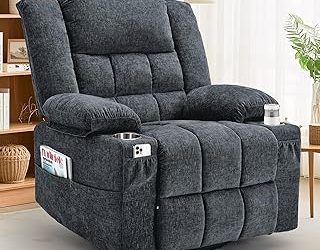
IPKIG Wingback Pushback Recliner with Massage and Heat
The wings do real work here, shielding your face from side glare so a nearby table lamp lights the page instead of your eyes. Button tufting and rivets pick up warm light in small glints, and the heat function makes this the natural choice for a cool north-facing corner where the light is flat all day.
Ashley Tulen Manual Rocker Recliner
A generously padded rocker in grey that holds its tone best under high-CRI warm bulbs — pair it with a shaded lamp rather than a bare fixture. Leave clearance behind it, since rocking motion will carry you in and out of a fixed lamp’s pool.
Terni Wood Arm Pushback Recliner
Sea Oat Beige performance fabric is the most forgiving surface in this group under mixed lighting: it diffuses evenly, resists shine, and warms nicely at 2700K. The exposed wood arms give the silhouette definition after dark, so it still reads as furniture rather than shadow.
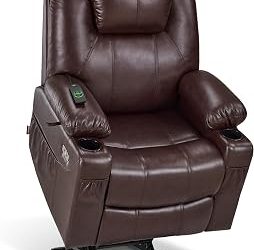
Faux Leather Manual Recliner in Brown
The thickened backrest and brown faux leather make this a low-light specialist — one warm lamp off to the side produces a soft sheen along the seams instead of a harsh reflection. Avoid placing it directly under a downlight, which will flatten the surface and highlight every crease.
Chocolate Pushback Recliner with Rivet Trim
Dark chocolate upholstery absorbs light, which is exactly what you want opposite a bright window or screen — no bounce, no competing glare. The rivet detailing supplies just enough sparkle to keep the outline legible in a dim room.
Frequently Asked Questions
Where should a reading lamp sit relative to a recliner?
Slightly behind the shoulder and above head height when reclined, angled down at the lap. That keeps the bulb out of your reclined sightline and puts light on the page. A wingback design tolerates a lower lamp because the wings block spill.
Does upholstery colour change how bright a room feels?
Noticeably. A pale beige recliner bounces light back into the room and can lift a dim corner; a chocolate or grey chair absorbs it and will make the same corner feel darker. In small rooms lit by one lamp, the lighter option often saves you a fixture.
Do heat and massage features affect placement?
Yes, they need mains power, so plan the chair and its lamp around available outlets. Running both from one point is usually fine, but avoid daisy-chaining extension leads across walkways.
Is faux leather a bad choice near a TV?
Not bad, just directional. Position it so the screen isn’t reflecting off the arms or headrest into your peripheral vision, and use a warm bias light behind the TV to reduce contrast.
Final Thoughts
For most rooms, the Terni Wood Arm Pushback is the safest bet — its performance fabric behaves predictably under almost any bulb, and the wood arms keep it visually grounded at night. Choose the IPKIG Wingback if you read after dark and want the wings doing glare control alongside the heat function, or the Chocolate Pushback if your seating faces a bright window or screen and you need a surface that absorbs light rather than throwing it back.