As an Amazon Associate we earn from qualifying purchases.
A red light therapy belt wraps the light source around your body instead of asking you to sit still in front of it. The flexible pad straps to your lower back, waist or abdomen and delivers red and near-infrared light while you read, work at a desk or move around the house. That wearable format is what separates belts from the other home devices in this niche: panels light a whole side of the body from a short distance, light therapy glasses sit in a frame in front of the eyes, and LED face masks rest directly on the face. A belt is the targeted option — smaller coverage, but it stays in place hands-free and follows the curve of your back or a bent joint. Below are five belts with verified listings, followed by the specs that actually differ between them.
Disclosure: This post contains affiliate links. If you purchase through these links, we may earn a small commission at no extra charge to you.
How to Choose a Red Light Therapy Belt
Wavelengths. Nearly every belt in this roundup pairs visible red light at 660nm with near-infrared light at 850nm. The red light works at the skin surface, while the near-infrared portion is the part makers aim at deeper tissue such as muscle and joints. One pick below, the DGYAO, uses 880nm near-infrared instead — a small variation on the same idea. Keep in mind that near-infrared light is invisible to the eye, so a section of the pad that looks dark while running is usually working as intended.
Coverage area and LED count. Light areas here range from a compact 12.6 x 6.3 inch pad to a wide 23.43 x 6.14 inch belt. A wide belt suits the lower back and waist, where you want many LEDs spread across a broad band of muscle. A smaller pad wraps a knee, elbow or shoulder more neatly and is easier to position on a joint.
Corded or cordless. Corded belts plug into a wall outlet or a USB power bank and never need charging, which suits a fixed spot on the sofa or at a desk. A cordless belt with a built-in battery lets you keep moving during a session, at the expense of charging time and a little extra weight in the controller.
Timer, modes and pulse. Look for an auto shut-off timer — 10 to 30 minute settings are typical — so a session ends on its own if you doze off. Intensity levels let you build up gradually, and several belts add a pulse mode, often 10Hz, that flickers the light for people who find steady output too intense.
Fit and care. Check the total belt and strap length against your waist before ordering; extension straps widen the fit range. A transparent TPU front film is worth having because it wipes clean and keeps sweat and skin oils off the LEDs.
Use notes. These are home wellness devices, not medical treatments. Follow the maker’s session limits, and talk with a clinician first if you are pregnant, light-sensitive, or taking medicine that increases sensitivity to light.
1. Viconor Red Light Therapy Belt
Top Pick
1. Viconor Red Light Therapy Belt
LEDs: 315 total — 105 red (660nm) and 210 near-infrared (850nm)
Light area: 23.43 x 6.14 in (142 sq in); belt length 49.6 in
Modes: 4 power levels (100%, 75%, 50%, 25%) plus pulse mode
Timer: controller with 30-minute default session and auto shut-off
The Viconor is the wide-coverage pick of this group. Its light area measures 23.43 x 6.14 inches — about 142 square inches — and packs 315 LEDs, split between 105 red lights at 660nm and 210 near-infrared lights at 850nm. The full belt runs 49.6 inches long, so it wraps most waists with room to spare.
The wired controller offers four power levels, from full output down to 25 percent, plus a pulse mode for sensitive skin. Sessions default to 30 minutes and shut off automatically at the end. Power is flexible: the belt runs from a USB power bank, a computer port or a wall adapter, so it works at a desk as easily as on the sofa. The pad itself is neoprene with a transparent TPU film front that wipes clean after use.
2. Comfytemp Red Light Therapy Belt (Corded)
Runner-Up
2. Comfytemp Red Light Therapy Belt (Corded)
LEDs: 126 lamp beads, each with 660nm red and 850nm near-infrared chips
Power draw: 22W, corded design
Belt size: 50 x 8 in; light coverage 22 x 8 in
Modes: 4 modes including 10Hz pulse; 3 strength levels
Comfytemp’s corded belt uses 126 lamp beads, and each bead carries two chips — one 660nm red and one 850nm near-infrared — so both wavelengths come from every point on the pad. Total draw is 22W, and the light coverage area is a generous 22 x 8 inches on a belt that measures 50 x 8 inches overall.
Four modes include a pulse setting that cycles all lights at a 10Hz rate, and output adjusts across three strength levels. The built-in timer switches the belt off after 20 minutes, which matches the maker’s suggested daily session length. A 5.9 ft wall outlet cable gives you reasonable freedom to shift position on a chair or bed while plugged in. This model is also FSA and HSA eligible.
3. DGYAO Red & Infrared Light Therapy Belt
3. DGYAO Red & Infrared Light Therapy Belt
LEDs: 117 total — 52 red (660nm) and 65 near-infrared (880nm)
Part number: RLT-WB01
Straps: two adjustable straps (long and short) included
Timer: controller timer function with auto shut-off
DGYAO is one of the longest-running names in this category, and its classic belt (part number RLT-WB01) takes a slightly different wavelength mix: 117 LEDs split between 52 red lights at 660nm and 65 near-infrared lights at 880nm, a touch deeper into the infrared band than the 850nm used by the other belts here.
The flexible pad ships with two adjustable straps — a long one for the back, hips and chest, and a short one for the neck, arms, shoulders, knees and elbows. The controller carries a timer function with auto shut-off, and sessions of 10 to 20 minutes are the maker’s typical guidance. A 15 ft power cord is the standout practical detail: you can cross a room or settle into a recliner without hunting for the nearest outlet.
4. ALLOLO Red Light Therapy Belt
4. ALLOLO Red Light Therapy Belt
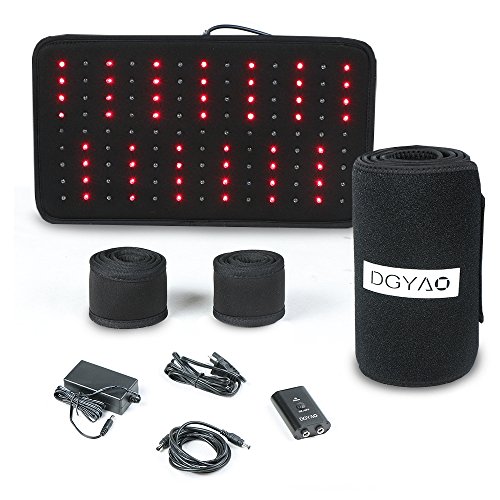
LEDs: 70 lamp beads with 3-in-1 chips (1 x 660nm red, 2 x 850nm infrared per bead)
The ALLOLO is the compact option. Its light area is 12.6 x 6.3 inches, small enough to wrap a knee or elbow cleanly, yet still wide enough to sit across the lower back. Inside are 70 lamp beads, and each bead holds a 3-in-1 chip — one 660nm red chip and two 850nm infrared chips — for 210 light chips in total.
Four modes cover red plus infrared together, red only, infrared only, and a pulse mode running at 10Hz. The timer remote steps through 5, 10, 15, 20, 25 and 30 minutes, the widest spread of session lengths in this roundup. Fit is handled by a 23.6 inch elastic strap plus a 31.5 inch extension belt, and the belt runs either from its adapter or from a USB power bank. Note that this is a light device rather than a heating pad — any warmth you feel comes from the LEDs themselves.
5. feangli Wireless Red Light Therapy Belt (YD079)
The feangli YD079 is the cordless pick. A built-in 5000mAh rechargeable battery frees you from the outlet entirely, and the wireless remote controller — with its own small display — handles settings while the belt stays wrapped around your waist. That makes it the easiest of the five to wear while tidying up, walking around the house or travelling.
The controller offers three light modes (660nm red only, 850nm infrared only, or both together), three brightness levels, and a 10Hz pulse mode. Timer settings run 10, 20 or 30 minutes with a countdown shut-off. The pad front is covered with a transparent TPU film that wipes clean. At 1.41 lb in the package, it is also the lightest belt here.
Timer: 10/20/30 minutes with countdown auto shut-off
Surface: transparent TPU film front
Package: 9.88 x 7.56 x 2.56 in; 1.41 lb
Which Red Light Therapy Belt Should You Buy?
For the broadest lower-back coverage, the Viconor’s 142 square inches of light and 315 LEDs are the strongest fit. If you want a set-and-forget daily routine next to an outlet, the Comfytemp’s fixed 20-minute shut-off and dual-chip beads keep things simple, and its FSA/HSA eligibility helps if you use a health account. The DGYAO suits anyone who wants one pad to move between waist and joints, thanks to its two straps and extra-long cord. Choose the ALLOLO if a knee, elbow or shoulder is your main target and you want finer timer steps. Pick the feangli YD079 if you know a cord will annoy you — it is the only fully cordless belt in this group.
Conclusion
Red light therapy belts trade the broad coverage of a panel for contact, convenience and a pad that stays put while you move. Match the light area to the body part you care about most, decide early whether you want a cord or a battery, and favor a belt with an auto shut-off timer so sessions end on time. Any of the five belts above covers those basics; the differences come down to size, wavelength mix and power style.
H
Home Beautiful Design Editorial Team
We compare specs, materials and verified owner reviews before a product earns a spot. Rankings are never paid.
Affiliate disclosure. As an Amazon Associate we earn from qualifying purchases at no extra cost to you. Prices accurate as of the date shown.
Discover the best reed diffuser for living rooms, bedrooms, and bathrooms. Compare five elegant, long-lasting reed diffusers for inviting home fragrance.


 4. ALLOLO Red Light Therapy Belt