Key takeaways
- Flow over pressure: GPM does the rinsing; PSI just adds risk. Anything from roughly 1.2 to 2.5 GPM will strip a soapy film off a car, and 1200 to 1900 PSI at the nozzle is plenty for paint. Treat higher PSI as headroom for concrete, not something you point at a door panel.
- A real soap stage: Foam is dwell time, and dwell time is what lifts grit before your mitt drags it across the clear coat. An onboard detergent tank is convenient; a dedicated foam cannon with an adjustable orifice gives thicker, longer-clinging suds.
- Electric or gas: Electric wins for garages, evening washes, and neighbors — no exhaust, low noise, instant start. Gas wins on runtime and reach when you’re doing three vehicles, a trailer, and the driveway in one afternoon.
- Hose length and reel: A 25-foot hose means moving the unit two or three times around a full-size truck. Thirty-five feet lets you circle it once. Kink-resistant hose matters more than you’d think when you’re working around wheel wells at ankle height.
- Nozzle set and stability: Look for a 40-degree tip and a soap tip at minimum, and skip the red 0-degree on anything painted. Anti-tip design and a wide stance keep the unit upright when you tug the hose from the far side of the vehicle.
What's inside
Spend enough years aiming light at surfaces and you learn something uncomfortable about cars: dirt is mostly a lighting problem. A sedan that looks spotless under flat garage fluorescents will show every tide line the moment low afternoon sun rakes across the hood at a shallow angle. That gap between “looks clean” and “is clean” is what sends most people shopping for a pressure washer in the first place, and it’s also why so many of them end up disappointed. They buy on peak PSI, blast the paint at close range, and end up with a finish that scatters light in all the wrong directions.
This guide approaches the choice the way I’d approach a room: think about the surface first, the tool second. Vehicles are curved, clear-coated, and full of soft trim, so what you actually want is generous water flow, controllable pressure, and a soap stage that gives dwell time. Below are six machines worth considering in 2026, spanning quiet electric units for a single driveway up to gas rigs for long sessions, plus the specs that genuinely matter and the ones that are marketing.
As an Amazon Associate we earn from qualifying purchases.


How to Choose a Pressure Washer For Vehicles (2026)
- Flow over pressure: GPM does the rinsing; PSI just adds risk. Anything from roughly 1.2 to 2.5 GPM will strip a soapy film off a car, and 1200 to 1900 PSI at the nozzle is plenty for paint. Treat higher PSI as headroom for concrete, not something you point at a door panel.
- A real soap stage: Foam is dwell time, and dwell time is what lifts grit before your mitt drags it across the clear coat. An onboard detergent tank is convenient; a dedicated foam cannon with an adjustable orifice gives thicker, longer-clinging suds.
- Electric or gas: Electric wins for garages, evening washes, and neighbors — no exhaust, low noise, instant start. Gas wins on runtime and reach when you’re doing three vehicles, a trailer, and the driveway in one afternoon.
- Hose length and reel: A 25-foot hose means moving the unit two or three times around a full-size truck. Thirty-five feet lets you circle it once. Kink-resistant hose matters more than you’d think when you’re working around wheel wells at ankle height.
- Nozzle set and stability: Look for a 40-degree tip and a soap tip at minimum, and skip the red 0-degree on anything painted. Anti-tip design and a wide stance keep the unit upright when you tug the hose from the far side of the vehicle.
The Best Pressure Washers For Vehicles (2026), Reviewed
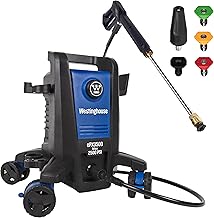
Westinghouse ePX3500
The most balanced all-rounder here: 2500 max PSI and 1.76 GPM is a genuinely useful combination for cars, and the anti-tipping base plus onboard soap tank make solo washes less of a wrestling match. The pro-style steel wand feels a class above the plastic trigger guns bundled with most electrics.
Greenworks 3000 PSI Brushless
Brushless motors run cooler and quieter, and at 2.0 GPM this is the electric unit I’d pick for someone who wants gas-adjacent rinsing power without waking the street at 7 a.m. It has the flow to clear a muddy truck bed and the manners to live in a tidy garage.
DeWalt DXPW3300-S
An AAA axial cam pump and 2.4 GPM make this the sensible entry point into gas, with enough output to handle vehicles, siding, and a stained patio in one session. Keep a 40-degree tip on it near paint and stand well back — this machine has far more pressure than any car needs.
Simpson ALH3425
The Honda GX200 and AAA triplex pump put this in professional territory, and the aluminum frame with a 35-foot hose is built for people who wash for a living. Overkill for one commuter car; ideal if you’re detailing a fleet or working through a long list of surfaces.
Greenworks 2100 PSI
At 1.2 GPM this is the light-duty pick, and it’s honest about that: apartment parking spots, motorcycles, one hatchback, occasional patio furniture. Pair it with a decent foam cannon and it will out-clean a garden hose by a wide margin without dominating your storage space.
Frequently Asked Questions
What PSI is safe on car paint?
Stay in the 1200 to 1900 PSI range at the nozzle, use a 40-degree tip, and hold the wand 12 to 18 inches away. Damage almost always comes from close range and narrow tips rather than from the machine’s rated maximum.
Do I need a foam cannon if the washer has a soap tank?
Not strictly, but a cannon produces thicker foam that clings longer, which is the whole point. The bright green kit with four quick-connect nozzles and a foam cannon is a cheap way to test whether you care about the difference.
Will a pressure washer alone get my car clean?
It gets it 80 percent there. Pre-rinse, foam, dwell, then a two-bucket contact wash with a soft mitt is what prevents the fine scratches that show up as haze under direct sunlight.
Electric or gas for home vehicle washing?
Electric, for most people. Gas earns its noise, fuel, and maintenance only if you’re running long sessions or tackling large hard surfaces regularly.
Final Thoughts
For most driveways, the Westinghouse ePX3500 is the pick — enough flow to rinse properly, a soap tank, and a wand that doesn’t feel disposable. Step up to the Greenworks 3000 PSI Brushless if you want quieter, stronger electric performance, or the DeWalt DXPW3300-S if vehicles are only part of a much longer cleaning list.