Mixing bowls are the quiet workhorses of the kitchen, but the first decision is not size or shape. It is material. Glass and stainless steel both mix, whisk, and store, yet they behave very differently once heat, microwaves, drops, and leftovers enter the picture. Glass is see-through, microwave friendly, and happy to double as a serving bowl. Stainless steel is light, tough, and easy to stack, but it cannot go in the microwave and hides its contents from view.
This comparison keeps the two materials separate. The first three sets are glass, the last two are stainless steel, and there is no universal winner at the end. The right pick depends on how you cook: whether you melt butter in the bowl, chill dough in the freezer, or simply want a stack of bowls that survives years of daily use without a chip or a crack.
As an Amazon Associate, we earn from qualifying purchases.
Quick answer
Glass mixing bowls suit cooks who microwave ingredients, want to see contents at a glance, and like bowls that can move from prep to table. Stainless steel suits cooks who value light weight, drop resistance, and compact nesting storage. Among these five sets, the M MCIRCO glass set adds airtight lids, while the Cuisinart steel set pairs three bowls with tight-fitting lids.
How to choose
Start with the microwave question, because it settles the material debate for many kitchens. Glass bowls can reheat sauces, melt chocolate, and warm butter right in the mixing bowl. Stainless steel cannot go in a microwave at all, so every reheating step means transferring food to another dish and washing both. If your baking routine involves frequent melting and warming, glass removes a whole category of friction.
Next, think about visibility. Glass lets you check whether flour is fully incorporated, watch dough rise, and spot the last streak of egg white from outside the bowl. Steel hides everything below the rim, which matters less for tossing salads and more for proofing, marinating, and storing leftovers you want to identify without opening a lid.
Weight and durability pull in the opposite direction. Steel bowls are light enough to hold in one hand while scraping with the other, and they dent rather than shatter when dropped. Glass is heavier, especially in large sizes, and a hard fall onto tile can end a bowl’s career. Households with young helpers or crowded, fast-moving kitchens often lean steel for everyday mixing and keep one glass bowl for microwave jobs.
Storage deserves a thought too. Nesting sets of either material stack neatly, but check the size range rather than the piece count. A ten-piece set may include several tiny prep bowls and only one genuinely large mixing bowl. Lids change the equation further: a set with well-fitting lids doubles as food storage, while a lidless set still needs separate containers for the fridge.
Finally, match the bowl to the task list. Freezer storage, oven use, and dishwasher habits all appear in the spec lists below, and they differ set by set even within the same material. Read the per-set details before deciding, because the headline material is only half the story.
The glass side
Anchor Hocking 10 Piece Mixing Bowl Set
Anchor Hocking’s ten-piece set is the traditional glass option: a deep stack of nesting bowls that covers everything from spice prep to a full batch of cookie dough. The page describes the glass as durable soda lime glass with tempered-tough construction, and the bowls are listed as dishwasher safe and microwave safe, with oven safety up to 425 degrees Fahrenheit per the manufacturer’s text. That oven rating sets it apart from the other glass sets here and makes it the glass pick for cooks who want one bowl to mix and bake in.
One caution: the product page gives two different size runs in its title and its description, and they do not agree on the largest bowl. Treat the exact size list as unsettled and confirm the current listing before ordering if a specific capacity matters to you. No lids are stated for this set, so fridge storage needs separate covers.
Specs
Material: Glass
Pieces: 10 nesting bowls
Sizes: not stated (the page lists conflicting size runs)
Lids: not stated
Dishwasher safe: Yes
Microwave safe: Yes
Oven safe: Up to 425 degrees Fahrenheit per manufacturer text
Luminarc’s ten-piece set takes a different approach to glass: the bowls are sized by diameter, running from 2.25 inches up to 10.25 inches across, which suits cooks who think in terms of footprint on the counter or in the cupboard. The set is clear glass from Arc Americas, listed as dishwasher safe and microwaveable, and the stackable design keeps the whole family in one tidy column.
The page does not state per-bowl quart capacities, and its single capacity field should not be read as the set’s total or the largest bowl’s size. No lids are stated either. This is a straightforward prep-and-serve set for cooks who value visibility and microwave access over storage features, and who are comfortable judging bowl size by diameter rather than volume.
The M MCIRCO set is the storage-focused glass option. Its four bowls are borosilicate glass in 0.8, 1.7, 2.9, and 4.8 quart sizes, and each comes with a see-through airtight lid, so a bowl of marinade or leftover batter can go straight into the fridge without a transfer. The bowls are listed as dishwasher safe and microwaveable; the lids are not dishwasher safe, according to the product page, so they need a quick hand wash.
Borosilicate glass is the draw here for cooks who move bowls between temperature extremes, and the graduated sizes cover small prep through a large mixing batch. The page’s piece-count wording varies between its product information and its description, but the contents are consistent where it counts: four bowls and four matching lids.
Cuisinart’s set keeps things focused: three stainless steel bowls in 1.5, 3, and 5 quart sizes, each with a tight-fitting lid. The “3-piece” name counts the bowls only; the box holds six items once the lids are included. The bowls are dishwasher safe and freezer safe per the product page, and as with all steel, they are not microwaveable.
This is the steel set for cooks who want storage built in. The three sizes map neatly onto everyday jobs: whisking dressings in the small bowl, tossing salads in the medium, and mixing big dough or popcorn batches in the large. The lids make the fridge handoff simple, which most steel sets do not offer.
FineDine’s six-piece set is the capacity spread of this comparison, running from a 0.75 quart bowl up through 1.5, 3, 4, and 5 quart sizes to a generous 8 quart bowl for double batches and party-size salads. The bowls have a mirror finish, flat bases that sit steady on the counter, and wide rolled rims that are easy to grip and pour from. Capacities are marked on the outside of the bowls, a small detail that saves guesswork mid-recipe.
No lids are stated for this variant, so plan on separate storage containers. The set is dishwasher safe and, like all stainless steel, not microwaveable. Use the size list given here, which comes from the product page itself; third-party roundups publish different lists for this set and should not be relied on.
Who should skip
Skip glass entirely if your kitchen sees frequent drops, if wrist strength makes heavy bowls a problem, or if you mostly mix outdoors or on the go, where steel’s toughness wins. Skip stainless steel if you melt and reheat in your mixing bowl daily, since every microwave step will cost you an extra dish. Skip the lidless sets, on either side, if your bowls double as your main leftover storage. And skip the largest nesting sets if your cupboard space is tight and you realistically use only two bowl sizes.
FAQ
Can stainless steel mixing bowls go in the microwave?
No. None of the steel sets in this comparison is microwaveable, and metal bowls should never be used in a microwave. If reheating in the mixing bowl matters, choose one of the glass sets instead.
Is borosilicate glass better than regular glass for mixing bowls?
Borosilicate glass, used in the M MCIRCO set, is generally chosen for better resistance to sudden temperature changes, such as moving from fridge to microwave. Regular glass sets like the Anchor Hocking and Luminarc are still dishwasher and microwave safe, but check each set’s stated ratings before exposing it to oven heat.
Do these sets come with lids?
Two of the five do. The M MCIRCO glass set includes four airtight lids, and the Cuisinart steel set includes three tight-fitting lids. Lids are not stated for the Anchor Hocking, Luminarc, or FineDine sets.
How many mixing bowls do I actually need?
Most home cooks use two or three sizes regularly: a small bowl for eggs and dressings, a medium for everyday mixing, and a large for dough and salads. Larger sets add specialty sizes that nest inside the same footprint, so they cost little extra storage space.
Final verdict
There is no overall winner here, only a better match for your habits. Choose glass if the microwave, oven, and see-through storage are central to how you cook: the Anchor Hocking set adds oven safety, the Luminarc set keeps things simple and stackable, and the M MCIRCO set is the pick when airtight lids matter most. Choose stainless steel if light weight, drop resistance, and easy nesting top your list: the Cuisinart set covers the core sizes with lids included, while the FineDine set stretches to an 8 quart bowl for big-batch cooks. Many kitchens end up with one set of each, and the spec lists above make it easy to see which combination covers your gaps.
Discover the best reed diffuser for living rooms, bedrooms, and bathrooms. Compare five elegant, long-lasting reed diffusers for inviting home fragrance.

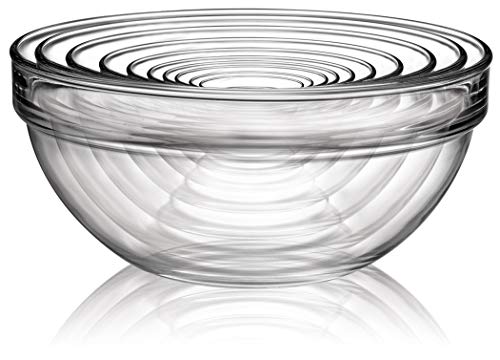


 FineDine Stainless Steel Mixing Bowls, Set of 6
 Cuisinart 3-Piece Stainless Steel Mixing Bowl Set with3-Piece Nesting Bowl Set3.9 poundsCheck on Amazon