The real decision with an ambient light rejecting screen is not the diagonal size. It is whether the surface geometry matches the angle your projector throws from, because an ALR screen built for an ultra short throw laser unit will actively ruin the picture from a ceiling mounted standard throw projector, and the reverse pairing washes out just as badly. Buyers also have to weigh how much overhead light the material turns away against how wide the seating area can be before the edges of the couch lose brightness.
This roundup is for living room and media room owners who watch with lamps on or curtains open, whether they run a UST laser projector on a media console or a standard throw unit across the room. Every pick below was chosen from the product names and specification fields published on its Amazon listing, then cross-checked against a second source before it earned a place here.
Quick Picks
As an Amazon Associate we earn from qualifying purchases
Product
Best for
Key spec from title
Elite Screens Aeon CineGrey 3D 120 inch
Standard throw projectors in family rooms with ceiling lights
65% rejection ratio with 1.2 gain
Elite Screens Aeon CLR 3 103 inch
UST laser projectors under bright overhead lighting
CLR 3 material rejects up to 90% of overhead light
AWOL Vision Cinematic ALR Screen 100 inch
UST setups that need the widest seating area
95% ceiling light rejecting with a 170 degree viewing angle
AWOL Vision Daylight ALR Screen 100 inch
Very bright rooms and daytime sports viewing
Fresnel surface with 85% ambient light resistance
VIVIDSTORM S PRO Floor Rising Screen 120 inch
Rooms where the screen must disappear after movie night
Motorized floor rising design with 97% ALR resistance
How to Choose
Match the Surface to Your Projector’s Throw Distance
ALR materials are directional optics, not neutral fabric. Lenticular and Fresnel surfaces such as the CLR 3 and the AWOL Daylight are ground to accept light arriving at a steep upward angle from an ultra short throw projector sitting inches below the screen, and they reject light coming from above. Angular reflective materials such as CineGrey 3D and CineGrey 5D expect a standard throw projector firing from across the room. Pairing either family with the wrong throw produces a dim, uneven image no setting can fix, so confirm your projector type before anything else.
Read Gain and Rejection Figures Together
A rejection percentage only tells half the story. A screen that turns away 95% of ceiling light but carries a 0.6 gain will look calmer and dimmer than a 1.2 gain surface with a lower rejection figure, especially with a mid brightness projector. As a working rule, UST laser units with strong light output tolerate low gain lenticular screens well, while standard throw projectors in the middle brightness range usually need the help of a gain figure at or above 1.0 to keep HDR scenes lively in a lit room.
Size the Screen to Your Seating, Not the Wall
Every ALR surface trades viewing angle for light rejection. A 170 degree figure keeps off-axis seats usable in a wide living room, while a 90 degree Fresnel cone concentrates brightness for a sofa placed squarely in front of the screen but fades for viewers at the sides. Measure the distance from the screen to your farthest regular seat and check the image height works for that row. A 120 inch diagonal suits most dedicated media rooms, while 100 to 103 inch screens fit typical living room walls without crowding speakers.
Decide Between Fixed Frame and Floor Rising Formats
A fixed frame screen holds its material under constant tension, which keeps lenticular and angular reflective surfaces optically flat and gives the sharpest result, but it claims the wall permanently and needs assembly and careful leveling. A motorized floor rising screen such as the VIVIDSTORM S PRO hides inside a floor case when the room returns to normal use, needs no wall mounting, and works well in rentals or multipurpose spaces. The trade is moving parts, a power connection near the floor, and a long case that must sit exactly parallel to the projector.
The 5 Best Options
Elite Screens Aeon CineGrey 3D 120 inch
Top Pick
Elite Screens Aeon CineGrey 3D 120 inch
Best for: Standard throw home theater in a family room with overhead lights.
120 inch diagonal, 16:9 aspect ratio
CineGrey 3D ceiling and ambient light rejecting material
Owners of standard throw projectors who refuse to watch in a cave will find this the most natural fit in the group. The CineGrey 3D material is angular reflective, so it suits ceiling mounted or rear shelf projectors, and its 1.2 gain keeps colors energetic while the surface turns away a stated 65% of ambient light. The EDGE FREE frame looks like a large flat panel on the wall, and the material carries ISF certification for color accuracy, which matters for film fans who calibrate.
Elite Screens Aeon CLR 3 103 inch
Runner-Up
Elite Screens Aeon CLR 3 103 inch
Best for: UST laser TV setups in bright living rooms with wide seating.
This is the fixed frame choice for a UST laser projector parked on a console in a room with strong ceiling lighting. The CLR 3 surface uses a ridged lenticular structure that absorbs up to 90% of overhead light while reflecting the projector’s steep upward beam back toward the seats. Gain sits at 0.8, lower than the CineGrey models, yet the 170 degree viewing angle keeps a wide sofa fully involved. The edge free split frame assembles on site and hangs on sliding wall brackets for centering.
AWOL Vision Cinematic ALR Screen 100 inch
AWOL Vision Cinematic ALR Screen 100 inch
Best for: UST owners who seat viewers across a wide sectional sofa.
AWOL builds this fixed frame screen around its HBSP black grid lenticular material, aimed squarely at ultra short throw laser projectors. The listing states a 95% ceiling light rejecting figure, the strongest overhead claim in this roundup, and the surface holds a wide 170 degree viewing angle so guests on the ends of a sectional still see an even picture. Peak gain is a modest 0.6 dB, which favors projectors with strong light output, and in return the screen keeps black levels deep and avoids hot spotting in the center of the image.
AWOL Vision Daylight ALR Screen 100 inch
AWOL Vision Daylight ALR Screen 100 inch
Best for: Bright living rooms where daytime viewing is the main event.
100 inch diagonal, 16:9 aspect ratio
Fresnel PET material, eight layer optical structure
Where the Cinematic screen targets ceiling light, the Daylight model goes after the hardest case: a room flooded with light from windows and overhead fixtures at once. Its Fresnel PET surface uses an eight layer optical structure to reach an 85% ambient light resistance figure while posting a higher 1.1 dB on-axis peak gain, so daytime football keeps its punch. The viewing angle narrows to 90 degrees, which suits a sofa centered on the screen. The rollable material assembles on site into a fixed frame with adjustable mounting height.
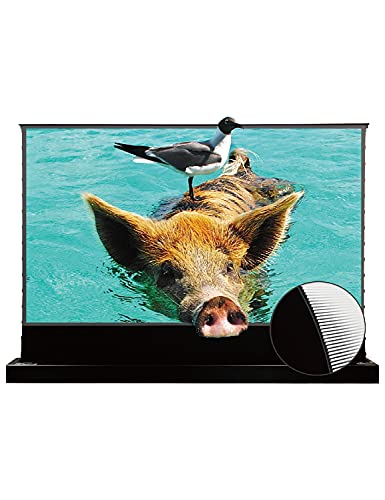
VIVIDSTORM S PRO Floor Rising Screen 120 inch
VIVIDSTORM S PRO Floor Rising Screen 120 inch
Best for: UST setups in rooms that cannot give up a wall to a screen.
120 inch diagonal, 16:9 aspect ratio
Ultra short throw ambient light rejecting material
Renters and multipurpose rooms get the strongest option here. The S PRO rises out of a slim floor case at the push of a button, so no wall mounting or drilling is involved, and it retracts fully when the room goes back to everyday use. The UST ALR material uses a sawtooth optical structure rated at 97% ALR resistance with a 0.6 gain and a 170 degree viewing angle, and the tab tensioned surface stays flat across the full 120 inches. Infrared and RF remotes are included, and the listing adds app and voice control.
Which One Fits Your Situation
Your Projector Sits on a Console Under the Screen
That is an ultra short throw layout, so stay inside the UST family. Choose the Aeon CLR 3 for a permanent wall installation with wide seating, the AWOL Cinematic if overhead light is your main enemy, or the Daylight Fresnel if windows flood the room during the day. All three expect the projector below the screen, never ceiling mounted.
Your Projector Is Ceiling Mounted Across the Room
A standard throw beam needs an angular reflective surface, and the Aeon CineGrey 3D is the pick built for that geometry. Its 1.2 gain helps mid brightness projectors hold HDR contrast with the lights on, and the 120 inch size fills a dedicated media wall convincingly. Avoid every UST-only screen in this list for this layout.
The Room Is a Living Room First and a Theater Second
The VIVIDSTORM S PRO floor rising screen keeps the room normal by day and cinematic at night, with no holes in the wall and no permanent black rectangle dominating the decor. It pairs with a UST projector on a low console, so the whole theater can appear or vanish in under a minute.
Daylight Viewing Matters More Than Movie Night
Pick the AWOL Daylight Fresnel screen. Its 85% resistance figure covers light arriving from the sides as well as overhead, and the 1.1 dB peak gain is the highest among the UST picks here, which is exactly the combination weekend sports in a bright room demands. Center the main sofa inside its 90 degree cone for the full effect.
Common Mistakes
Buying a UST-only lenticular screen for a standard throw projector, or the reverse, which guarantees a dim and uneven image.
Chasing the highest rejection percentage while ignoring gain, then finding HDR scenes too dark for the projector’s output.
Ordering a 120 inch screen before checking that the projector can fill it from its fixed position at the right image height.
Placing a Fresnel screen where key seats sit outside its 90 degree viewing cone.
Forgetting that floor rising screens need power and a clear, level stretch of floor exactly parallel to the projector.
Frequently Asked Questions
Can I use an ALR screen with a regular ceiling mounted projector?
Yes, but only with a material made for standard throw geometry, such as the CineGrey 3D in this roundup. Lenticular and Fresnel screens shaped for ultra short throw beams will reject much of a long throw image along with the room light, leaving a dim picture with visible hot spotting.
Does a higher rejection percentage always mean a better picture?
No. Rejection describes how much ambient light the surface turns away, while gain describes how much projector light reaches your seat. A 97% rejection screen with 0.6 gain can look darker than a 65% rejection screen with 1.2 gain, so match both figures to your projector’s brightness and your room.
What size ALR screen works best in a living room?
Most living rooms land between 100 and 120 inches. A 100 or 103 inch screen fits a typical wall with speakers beside it and suits seating eight to ten feet away, while 120 inches rewards a longer room. Always confirm the projector’s throw distance can produce the size you order before buying.
Do ALR screens work in a completely dark room?
They work, but their advantages shrink. In darkness a matte white screen usually returns more brightness per lumen, and the narrow viewing cones of Fresnel and lenticular surfaces can show texture during very dark scenes. ALR earns its place when lamps, windows, or ceiling lights share the room with the projector.
H
Home Beautiful Design Editorial Team
We compare specs, materials and verified owner reviews before a product earns a spot. Rankings are never paid.
Affiliate disclosure. As an Amazon Associate we earn from qualifying purchases at no extra cost to you. Prices accurate as of the date shown.
Discover the best reed diffuser for living rooms, bedrooms, and bathrooms. Compare five elegant, long-lasting reed diffusers for inviting home fragrance.


 AWOL Vision Daylight ALR Screen 100 inch
 VIVIDSTORM S PRO Floor Rising Screen 120 inch