A landing pad earns its place in a drone kit by keeping grit, seeds and dust out of motors and gimbals, but once the light drops, a pad disappears into the ground it sits on. An LED landing pad solves the second problem as well: a lit rim marks the home point from the air, so the final descent aims at a glowing target instead of a dark patch of lawn. The decision is matching pad size and light design to the drone you fly.
OUR TOP PICK
Drone Landing Pad with Night Vision LED Light, 27.6 inch
This roundup is for pilots flying DJI Mini, Mavic, Air, Avata and Neo drones who want to keep flying into dusk without guessing where the pad sits. Every pad below has LED lighting built into or supplied with the pad, not reflective print or glow in the dark pigment. The three picks were chosen from the names, sizes, weights and light specifications on their Amazon product pages, and they split by size: one round pad, one ring light pad and one square apron.
Quick Picks
As an Amazon Associate we earn from qualifying purchases.
Product
Best for
Key spec from title
Drone Landing Pad with Night Vision LED Light, 27.6 inch
Larger DJI drones flown at dusk from grass or gravel
27.6 inch (70 cm) diameter with removable LED strip
STARTRC Drones Landing Pad with LED Light
Mini-series pilots who want many light modes in a small pack size
21.6 inch pad with 15 LED light modes
CYNOVA Drone Landing Pad with LED Lights, 65 cm
Mavic and Avata pilots who want a square lit apron
65 cm square with built-in LED lights
How to Choose
Pad size versus your drone’s footprint
Start with the airframe, not the light. A pad only protects motors and props when the whole drone sits inside its border with room to spare, because a landing gear leg hanging over the edge still dips into grass and grit. Sub-249 gram drones in the Mini and Neo class sit comfortably on a pad around 21.6 inches across. Mavic, Air and Avata class machines land more safely on 65 to 70 cm of surface. Bigger is rarely worse for protection, but every extra inch adds folded bulk and weight to your bag, so match the pad to the largest drone you actually fly rather than the largest one you might buy someday.
How the LED light is arranged and powered
LED layouts fall into three camps: a removable strip clipped around the rim, a built-in ring that lights the full perimeter, and a strip sewn into a square apron. A full ring or perimeter strip reads best from altitude because the drone sees a closed shape instead of a single line. Mode counts vary widely, from a simple steady glow to 15 switchable patterns on the STARTRC pad. Flashing modes help you spot the pad from far away, while a steady mode is easier on the eyes during the final descent. Before ordering, check how the light is powered and charged on the product page, since listings headline modes and size more often than battery details.
Weight, edges and staying put in prop wash
A light pad that skitters across the patio in prop wash is worse than no pad at all. Weighted borders are the simplest fix, and two of the three pads here build weight into the design so the rim stays planted when the drone spools up. Heavier aprons, such as the square CYNOVA at 65 cm, trade pack weight for stability on breezy evenings. Ground stakes and pegs help on soft soil but slow you down on pavement and decking, where a weighted rim works anywhere. If you mostly fly from a backyard patio, weight matters more than anchors; if you fly from open fields, look for both.
Material and double-sided visibility
Pad surfaces take sun, dew and repeated folding, so the fabric decides how long the printed target stays readable. High nylon and PU surfaces both shed water and wipe clean, and a stain-resistant finish keeps mud from ghosting through the print. Double-sided pads print a different color scheme on each face, which matters more than it sounds: a bright orange face reads well on green grass, while the reverse tone stands out on pale concrete or sand. Pick the face that contrasts with your usual flying field, and fold the pad with the used side inward so grit picked up outdoors does not grind against the clean face in your bag.
The 3 Best Options
Drone Landing Pad with Night Vision LED Light, 27.6 inch
Top Pick
Drone Landing Pad with Night Vision LED Light, 27.6 inch
Best for: Pilots flying Mavic-class drones at dusk who want the widest lit target in this roundup.
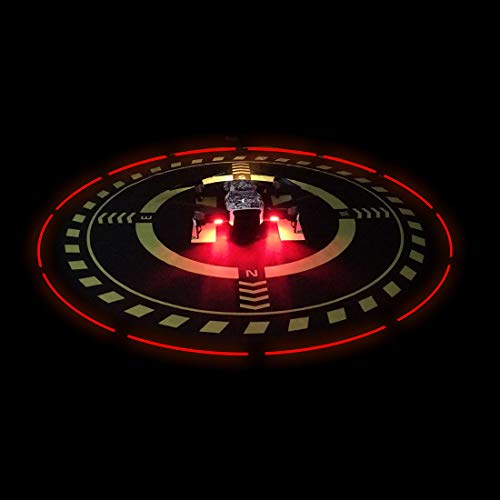
This is the widest target in the roundup, and it suits pilots who fly Mavic-class drones from grass, gravel or uneven ground at dusk. The 27.6 inch (70 cm) round surface leaves a margin around bigger airframes, the weighted fast-fold body sits flat without pegs, and the double-sided high-contrast print gives a home point in daylight. After sunset, the removable LED strip switches the rim from printed target to glowing outline, which is exactly the moment a plain pad stops being visible from altitude. At 13.1 ounces it packs down to an 11 x 8 x 2 inch bundle with its storage bag.
Watch out for: The LED strip is a separate removable part, so keep track of it when packing up in the dark.
STARTRC Drones Landing Pad with LED Light
Runner-Up
STARTRC Drones Landing Pad with LED Light
Best for: Mini and Neo pilots who want the most light modes in the smallest folded package.
Unfolded size: 21.6 inches
Folded size: 11.8 x 7.87 inches
Item weight: 374 grams
Lighting: LED ring with 15 light modes and one-key switching
Mini and Neo pilots who want the most light modes in the smallest folded package.
Watch out for
Check the product page for how the light ring is powered before ordering, since the headline specs focus on modes and size rather than battery details.
STARTRC takes the opposite approach: a smaller 21.6 inch pad built around its light ring. The LED runs the full perimeter with 360-degree output and 15 light modes switched by a single key, so you can run a steady ring for landing or a flashing pattern for finding the pad. The PU surface is double-sided in two colors with a stain-resistant finish, and at 374 grams it folds to 11.8 x 7.87 inches, small enough to ride in a Mini carry case. The listed compatibility spans the DJI range from the Neo and Avata 2 down through the Spark, making it an easy match for mixed fleets of drones.
Watch out for: Check the product page for how the light ring is powered before ordering, since the headline specs focus on modes and size rather than battery details.
CYNOVA Drone Landing Pad with LED Lights, 65 cm
CYNOVA Drone Landing Pad with LED Lights, 65 cm
Best for: Mavic, Air and Avata pilots who prefer a square apron with built-in perimeter lighting.
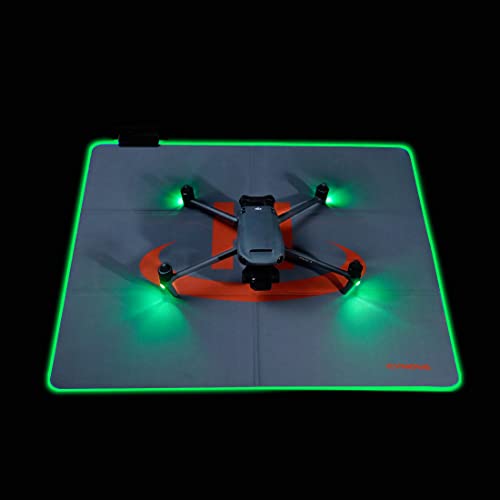
The CYNOVA is the square option: a 65 cm fast-foldable apron with LED lights built in, aimed squarely at the Mavic and Avata crowd. A square apron gives corner room that round pads trim away, which helps when a cinewhoop settles off center, and the flat sides fold into a rectangle instead of a disc. The surface pairs PU leather with neoprene, which shrugs off damp grass and wipes clean after muddy sessions. Its listed fit covers the Mini 3 Pro, Mavic Air 2, Air 2S, Mavic Mini 2, Avata, Mavic 3 and DJI FPV, so one apron can serve a mixed fleet without swapping pads between flights.
Watch out for: CYNOVA’s range changes often, so confirm the 65 cm LED version is the variant selected on the product page before ordering.
Which One Fits Your Situation
You fly a Mini at dusk in the park
Take the STARTRC. Its 21.6 inch surface is sized for Mini-class airframes, the 374 gram body disappears into a small carry case, and the 15-mode ring lets you run a flashing pattern while you walk out and a steady ring for the landing itself. The double-sided print also gives you a face that contrasts with grass and one that works on the paved paths where park flying often ends.
You fly a Mavic or Air from rough ground
Take the 27.6 inch Night Vision pad. Bigger airframes need the wider margin, the weighted body holds its shape on gravel and tufted grass without pegs, and the removable strip means a torn or tired light can be swapped without replacing the whole pad. The high nylon surface also shrugs off the damp ground that evening sessions usually involve.
You want a square apron for Avata and FPV work
Take the CYNOVA 65 cm. Cinewhoops and FPV drones do not always settle dead center, and the square corners give that drift somewhere safe to land. The built-in lights keep the apron readable under goggles-off final checks, and the PU leather and neoprene surface stands up to the damp fields and parking lots where FPV sessions tend to happen.
You hike to your launch spots
Take the STARTRC again, and leave the bigger pads for car-based flying. Folded to 11.8 x 7.87 inches at 374 grams, it is the only pad here that fits a daypack side pocket without a fight. You give up landing margin for the largest drones, but for a Mini or Neo carried up a trail, the compact ring light pad is the one that actually comes along.
Common Mistakes
Buying a reflective or glow in the dark pad and expecting real light: printed reflective borders only shine when a light source hits them, and glow pigment fades fast, so check that the listing names actual LED lighting.
Choosing a pad barely wider than the drone: landing gear at the very edge still dips into grass and grit, which defeats the point of carrying a pad at all.
Ignoring how the light is powered: listings headline mode counts, so confirm the charging method and what is included on the product page before the pad arrives.
Leaving a lightweight pad unweighted on a breezy evening: prop wash and gusts can shift or flip an unsecured rim mid-landing, right when the drone is closest to the ground.
Treating a lit pad as a substitute for night flight rules: the pad lights your landing spot, but your drone still needs to meet the anti-collision lighting and visibility requirements that apply where you fly.
Frequently Asked Questions
Does an LED landing pad help the drone’s downward sensors?
Partly. Downward vision systems read contrast and texture, and a printed pad gives them an easier target than plain grass. The LED ring mainly helps you, by marking the home point from altitude and in low light. Treat the light as a visibility aid for your eyes first and a bonus for the sensors second, and keep landings deliberate.
How long do the lights on these pads run between charges?
It depends on the model and the mode, and the listings headline mode counts rather than run times. Flashing modes draw less than a steady full-brightness ring on any lighted pad. The habit is simple: charge the pad or its strip after every night session, and check the product page for the battery details of the exact variant you order, because sellers update these accessories without renaming them.
What size pad does a DJI Mini actually need?
A Mini-class drone sits on a pad around 21.6 inches across, the size of the STARTRC pad above. The pad should clear the drone’s full footprint with a margin on every side so the props and landing gear stay over the surface. If you also fly a Mavic or Air, step up to a 65 to 70 cm pad instead of asking one small pad to serve both fleets.
Can I use an LED landing pad on wet ground?
The pads here use waterproof surfaces such as high nylon and PU, so damp grass and light dew are fine for the fabric. The light strip, ring connectors and control keys deserve more care: wipe them dry before folding, and avoid leaving a powered pad sitting in standing water. Let the pad dry before it goes back in the bag, which also keeps the faces from sticking in storage.
H
Home Beautiful Design Editorial Team
We compare specs, materials and verified owner reviews before a product earns a spot. Rankings are never paid.
Affiliate disclosure. As an Amazon Associate we earn from qualifying purchases at no extra cost to you. Prices accurate as of the date shown.
Discover the best reed diffuser for living rooms, bedrooms, and bathrooms. Compare five elegant, long-lasting reed diffusers for inviting home fragrance.