Our Top Picks
 First Alert Hardwire Combination Smoke & Carbon Monoxide1-Pack8 x 7.5 x 3.5 inches0.56 poundsCheck on Amazon
 First Alert 2-in-1 Z-Wave Wireless Smoke Detector &Z-Wave Combo Alarm8 x 7 x 2.5 inches0.69 poundsCheck on Amazon
Smoke and carbon monoxide detectors differ in four practical ways: what they sense, how they are powered, how they connect to each other, and how they alert you. Combination units sense both smoke and carbon monoxide in one housing, while dedicated units sense one or the other. Power runs from hardwired mains with battery backup, through long-life sealed batteries, to plug-in units that draw from a wall outlet.
The five models below form a ladder from a Wi-Fi smart hardwired alarm, through hardwired interconnect and Z-Wave battery models, to a 10-year sealed-battery unit and a plug-in carbon monoxide only detector. Every detail is taken from the product listings and maker documentation. Placement, quantity and replacement timing are matters for the manufacturer’s instructions and your local code or fire-marshal guidance, so treat those sources as the authority for your home.
As an Amazon Associate, we earn from qualifying purchases.
Quick answer
The First Alert SC5 is the smart pick, a hardwired combination alarm with Wi-Fi phone alerts. The First Alert SMICO100-AC covers hardwired interconnect with battery backup, the First Alert ZCOMBO is a battery combination unit that needs a Z-Wave hub for phone alerts, the Kidde P4010DCSCO-W pairs a 10-year sealed battery with wireless interconnect, and the Kidde Nighthawk is a plug-in carbon monoxide only detector.
First Alert SC5 Hardwire Smart Smoke & Carbon Monoxide Alarm (SMCO600NV-AC)
The SC5 sits at the top of the ladder as the connected option. It is a hardwired combination smoke and carbon monoxide alarm with built-in Wi-Fi, and maker documentation describes phone alerts through the Resideo Connect and First Alert app, alongside voice alerts that name the hazard type and the room location programmed into the unit. It also works with the Google Home app, and Google and First Alert position it as the replacement for the discontinued Nest Protect line.
Power is hardwired, with a 3V lithium backup cell that the maker states is not replaceable. A Quick Connect plug is part of the package per the maker, which matters for homes replacing existing hardwired alarms on the same wiring. The maker states conformance to UL 217 10th Edition. As with any hardwired model, fitting involves mains wiring, so the manufacturer’s instructions and local code govern how it should be installed.
| Spec | Detail |
|---|---|
| Model | SMCO600NV-AC |
| Detection | Smoke and carbon monoxide combination |
| Power | Hardwired, with 3V lithium backup cell (not replaceable, per maker) |
| Connectivity | Wi-Fi; Resideo Connect and First Alert app alerts per maker documentation |
| Alerts | Voice alerts naming hazard type and location |
| Standard | UL 217 10th Edition conformance, as stated by the maker |
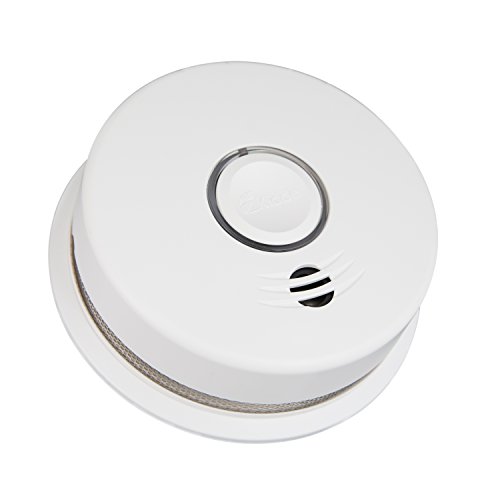

First Alert Combination Smoke & Carbon Monoxide Alarm (SMICO100-AC)
The SMICO100-AC is the conventional hardwired option. The listing describes First Alert Precision Detection technology, and the unit wires into a home’s existing alarm circuit so that linked alarms sound together through the hardwired interconnect. That interconnect behaviour is the main reason to choose a hardwired model when a home already has alarm wiring in place.
It runs on 120V AC power with a 9V battery backup, and an Easy Adapter Plug is included in the box per the listing, which simplifies swapping certain older hardwired units onto the existing plug. There is no app or voice alerting here; the feature set is the wired interconnect, the mains power supply and the battery backup. Buyers replacing one alarm in a wired set should check the listing for compatibility notes on mixing models within an interconnect circuit.
| Spec | Detail |
|---|---|
| Model | SMICO100-AC |
| Detection | Smoke and carbon monoxide combination |
| Power | 120V AC hardwired, with 9V battery backup |
| Interconnect | Hardwired interconnect, linked alarms sound together |
| Included | Easy Adapter Plug |
| Alerts | Alarm horn; no app alerts listed |
First Alert 2-in-1 Z-Wave Wireless Smoke Detector & Carbon Monoxide Alarm (ZCOMBO)
The ZCOMBO takes the battery route. It pairs a photoelectric smoke sensor with an electrochemical carbon monoxide sensor in one unit, with an 85 dB horn, a tamper-resistant battery door and a single button for testing and silencing. The listing gives a 7-year manufacturer warranty.
Its smart behaviour depends on a hub: the unit is designed for Ring Alarm and other certified Z-Wave systems, and a Z-Wave hub is required for phone alerts. Without a hub, it works as a standalone battery alarm with its horn, and nothing in the listing provides app notifications on its own. That distinction is the key buying point for this model, since shoppers sometimes assume a wireless alarm sends phone alerts by itself. For homes that already run a Z-Wave system, it adds smoke and carbon monoxide sensing to that system; for homes without one, the hub is an extra purchase to plan for.
| Spec | Detail |
|---|---|
| Model | ZCOMBO |
| Detection | Photoelectric smoke sensor plus electrochemical carbon monoxide sensor |
| Power | Battery operated |
| Connectivity | Z-Wave; hub required for phone alerts |
| Horn | 85 dB |
| Warranty | 7-year manufacturer warranty, per listing |
Kidde Smoke & Carbon Monoxide Detector, 10-Year Battery (P4010DCSCO-W)
This Kidde combination unit removes battery changes from the routine by using a sealed lithium battery rated for 10 years per the listing. It combines photoelectric smoke sensing with an electrochemical carbon monoxide sensor, and adds voice alerts alongside the alarm sound and LED indicators, so an alert announces the hazard type as well as sounding.
Its interconnect is wireless rather than wired: the listing states up to 24 Kidde devices can be linked, and the same listing notes the NFPA initiation-device limits that apply to such networks. That makes it a route to interconnected alarms in homes without alarm wiring, using compatible Kidde units. The listing states UL certification and a 10-year limited warranty. Because the battery is sealed, the whole unit is replaced at end of life rather than fitted with new cells, following the manufacturer’s instructions.
| Spec | Detail |
|---|---|
| Model | P4010DCSCO-W |
| Detection | Photoelectric smoke sensor plus electrochemical carbon monoxide sensor |
| Power | 10-year sealed lithium battery |
| Interconnect | Wireless, up to 24 Kidde devices per listing |
| Alerts | Voice alerts, alarm horn and LED indicators |
| Warranty | 10-year limited warranty, per listing |
Kidde Nighthawk Carbon Monoxide Detector, Plug In with Battery Backup (KN-COPP-3)

The Nighthawk needs stating plainly: it is a carbon monoxide only detector. It has no smoke sensor, so it does not substitute for a smoke alarm or a combination unit; it covers the dedicated carbon monoxide role only. It uses an electrochemical sensor and plugs into a standard 120V AC outlet, with a 9V battery backup per the listing.
Its distinguishing feature is the digital LED display, which shows carbon monoxide levels across a 30 to 999 PPM range per the listing, with a peak-level memory that records the highest reading since the last reset. The alarm horn is rated at 85 dB, and the listing states UL 2034. A plug-in unit suits rooms where an outlet sits at a suitable position per the manufacturer’s placement instructions, and it can be moved between outlets when a room layout changes. Availability can change, so confirm the current listing before ordering.
| Spec | Detail |
|---|---|
| Model | KN-COPP-3 |
| Detection | Carbon monoxide only; no smoke sensor |
| Sensor | Electrochemical |
| Display | Digital LED, 30 to 999 PPM range with peak-level memory, per listing |
| Power | Plug-in 120V AC, with 9V battery backup |
| Horn and standard | 85 dB; UL 2034, as stated in the listing |
How to choose
Match the sensor set to the job first. Combination units cover smoke and carbon monoxide in one housing; a carbon monoxide only unit like the Nighthawk covers just one of those roles, so plan smoke detection separately wherever it is needed. Next, look at power: hardwired models suit homes with existing alarm wiring, sealed 10-year batteries remove battery changes, battery Z-Wave units trade on system integration, and plug-in units need a suitably placed outlet.
Then consider interconnect and alerts. Hardwired and wireless interconnect models are designed so linked alarms sound together, while smart models add phone alerts, with the important caveat that the ZCOMBO needs a Z-Wave hub for them. Check the standards and sensor details exactly as each listing states them, and follow the manufacturer’s instructions plus local code or fire-marshal guidance for placement, quantity and replacement timing, since those rules vary by area and home.
Who should skip
Skip the hardwired models if your home has no alarm wiring and you are not arranging installation work, since both assume a wired circuit. Skip the ZCOMBO if you want phone alerts but have no Z-Wave hub and no plans to add one. Skip the Nighthawk as your only detector purchase if you still need smoke detection, because it senses carbon monoxide only. And skip mixing brands within an interconnect plan until you have checked each listing’s compatibility notes, since interconnect systems are generally designed around matched units.
FAQ
What is the difference between a combination alarm and a carbon monoxide only detector?
A combination alarm contains both a smoke sensor and a carbon monoxide sensor in one unit. A carbon monoxide only detector, such as the Kidde Nighthawk in this guide, contains only the carbon monoxide sensor and provides no smoke detection at all.
Do these detectors send phone alerts on their own?
It depends on the model. The First Alert SC5 has built-in Wi-Fi and sends app alerts per the maker’s documentation. The First Alert ZCOMBO only sends phone alerts through a connected Z-Wave hub, such as a Ring Alarm system; without a hub it operates as a standalone alarm.
How long do detectors last before replacement?
Detectors have finite service lives and give end-of-life signals, with exact timing set by each manufacturer. The Kidde P4010DCSCO-W uses a sealed battery rated for 10 years per its listing. Follow the manufacturer’s instructions and local guidance for replacement timing on any model.
Where should detectors be placed in a home?
Placement rules come from the manufacturer’s instructions and your local code or fire-marshal guidance, and they vary by home and area. Follow those sources for the number of units, their rooms and their mounting positions rather than general rules of thumb.
Final verdict
Choose the First Alert SC5 for Wi-Fi alerts on a hardwired circuit, the SMICO100-AC for a straightforward wired interconnect replacement, the ZCOMBO if a Z-Wave system is already in place, and the Kidde P4010DCSCO-W for wireless interconnect with a sealed 10-year battery. Add the Kidde Nighthawk where a dedicated plug-in carbon monoxide display is wanted, remembering it covers carbon monoxide only. In every case, let the manufacturer’s instructions and local code decide placement and replacement.
More from Amazon
Programs that pair well with the guide above. Offers and eligibility are set by Amazon and may change.
Collect the home and kitchen items you want in one registry that guests can shop from.
Create a wedding registrySet up recurring deliveries of everyday items on eligible products. Terms and savings are set by Amazon.
Explore Subscribe & SaveFree shipping on eligible items, Prime Video and more. Eligible new members can start with a free trial.
Start a Prime free trialAudiobooks and podcasts to listen to on the go. Eligible new members can start with a free trial.
Try Audible freeAs an Amazon Associate we earn from qualifying purchases.