Key takeaways
- Weight: A bench weighing roughly 45–80 pounds is a practical middle ground for transport and stability. Permanent benches can be substantially heavier.
- Footprint: Look for legs spread widely enough to resist side-to-side movement. A base around 24–30 inches deep is more reassuring than a narrow pedestal.
- Leg bracing: Cross-braces and welded frames usually flex less than lightly bolted tubular legs.
- Leveling feet: Adjustable feet are valuable on gravel, uneven concrete, and outdoor firing points. They matter less on a flat indoor floor.
- Joint quality: Folding hinges and locking pins are common wear points. They should lock without noticeable play.
The best shooting benches are the ones that match your range, rifle, and transport needs: a heavy fixed bench for maximum stability, a folding steel bench for occasional outdoor use, or a height-adjustable bench when multiple shooters share the firing point.
Best Shooting Benches by Shooting Situation
| Situation | Best bench type | Why it fits | Typical 2026 market range |
|---|---|---|---|
| Permanent private range | Fixed steel or concrete-supported bench | Highest stability, generous surface, no setup before practice | $400–$1,200+ |
| Public range with vehicle access | Folding steel bench | Stable enough for most practice and easier to transport | $150–$450 |
| Long walk from parking area | Lightweight folding or modular bench | Lower carrying weight, faster setup, but more movement under recoil | $100–$350 |
| Several shooters sharing one station | Height-adjustable bench | Accommodates different seated positions and chair heights | $250–$700 |
| Precision rimfire or low-recoil practice | Compact bench with a rigid top | Usually sufficient without the weight of a full-size platform | $120–$350 |
What Makes a Shooting Bench Stable?
Stability comes from the interaction of weight, leg geometry, feet, frame stiffness, and the surface beneath the bench. A heavy bench is not automatically a stable one: narrow legs, flexible joints, or small feet can still allow rocking.
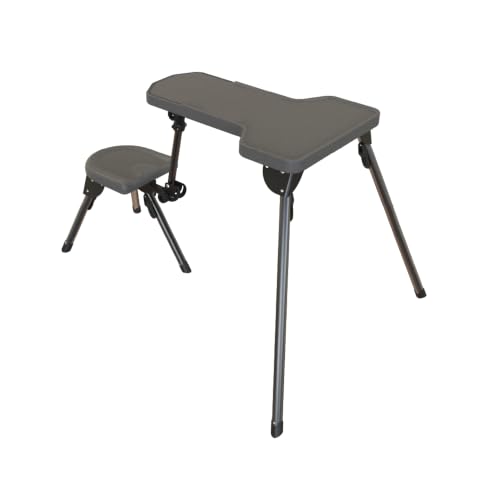
Caldwell Stable Table Shooting Bench, Collapsible Frame
Included for 'Best Shooting Benches for Stable Practice' because the listing specifies Collapsible Frame, details this guide uses to compare options.
View on Amazon
Caldwell Stable Table Shooting Bench, Tripod Frame
Included for 'Best Shooting Benches for Stable Practice' because the listing specifies Tripod Frame, details this guide uses to compare options.
View on Amazon
MTM PST-11 Predator Shooting Table, Portable Benchrest, Durable Molded Design, Shooting Platform, Target Shooting & Range Accessory, Green
Included for 'Best Shooting Benches for Stable Practice' because the listing specifies Portable Benchrest and Durable Molded Design, details this guide uses to compare options.
View on Amazon
Birchwood Casey Xtreme Adjustable Shooting Bench with Thick Padded Back Rest, Seat, Cup Holder, Ez Access Gear Basket & Gear Hook
Included for 'Best Shooting Benches for Stable Practice' because the listing specifies Seat and Cup Holder, details this guide uses to compare options.
View on Amazon- Weight: A bench weighing roughly 45–80 pounds is a practical middle ground for transport and stability. Permanent benches can be substantially heavier.
- Footprint: Look for legs spread widely enough to resist side-to-side movement. A base around 24–30 inches deep is more reassuring than a narrow pedestal.
- Leg bracing: Cross-braces and welded frames usually flex less than lightly bolted tubular legs.
- Leveling feet: Adjustable feet are valuable on gravel, uneven concrete, and outdoor firing points. They matter less on a flat indoor floor.
- Joint quality: Folding hinges and locking pins are common wear points. They should lock without noticeable play.
For higher-recoil rifles, a fixed or very heavy bench is preferable. For rimfire, air rifle, and supported pistol practice, a lighter folding design can work well if its legs lock firmly and the top does not twist when pressure is applied near an edge.
Choose the Right Shooting-Surface Size
The top needs to support the rifle, front and rear rests or a bipod, ammunition, hearing protection, and your elbows without forcing equipment close to the edge. A useful minimum is about 30 inches wide by 20 inches deep. A more comfortable precision setup is 36–48 inches wide by 24–30 inches deep.
| Surface size | Suitable use | What to expect |
|---|---|---|
| 24 × 18 inches | Compact rimfire or pistol support | Easy to carry, limited room for rests and accessories |
| 30 × 20 inches | General recreational rifle practice | A workable minimum for one shooter |
| 36 × 24 inches | Most all-purpose bench shooting | Room for a rifle, rests, ammunition, and elbows |
| 48 × 30 inches | Precision setups or shared equipment | Comfortable, but heavier and harder to fit in a vehicle |
Check whether the published dimensions describe the entire frame or only the usable top. A raised rim, side tray, or sharply rounded edge can reduce practical workspace. A smooth, matte surface is generally easier to clean and less distracting than a glossy finish.
Height and Ergonomics Matter More Than They Seem
Most seated shooting benches fall near 28–32 inches high, but the correct height depends on the chair and the rifle rest. Your shoulders should remain relaxed, with your forearms supported without shrugging or leaning heavily into the bench.
An adjustable bench is useful when the same station is used by adults of different heights. A range of approximately 26–34 inches covers many seated positions. If a bench is too high, a lower chair may not solve the problem because your knees can rise into the underside. Measure the clearance beneath the top, not only the overall height.
For a compact setup in a 10 × 12-foot room, allow at least 36 inches behind the chair for safe movement and approximately 30 inches beside the bench for access. In a vehicle, measure the folded length and width as well as the weight; a bench that fits the trunk on paper may still be awkward through a narrow doorway or around a wheel well.
Fixed, Folding, or Modular?
Fixed benches
Fixed benches provide the best resistance to movement. They are appropriate for a private range where the firing point remains in one location. Their disadvantages are installation, limited flexibility, and transport difficulty. A permanent top may also require drainage or weather protection if it remains outdoors.
Folding benches
Folding models are the most versatile choice for public ranges. Look for positive locking pins, a frame that folds without pinching fingers, and feet that remain attached during transport. The compromise is that every hinge introduces a potential source of flex or looseness. Recheck fasteners periodically, especially after carrying the bench over rough ground.
Modular benches
Modular designs separate the top, legs, and accessories. They can be easier to repair or store, and some let you change the top size. Assembly takes longer, however, and loosely fitted connections can undermine the stability that the heavier parts were intended to provide.
Materials: Stability Versus Weight
| Construction | Advantages | Trade-offs | Best setting |
|---|---|---|---|
| Welded steel frame | Rigid, durable, good resistance to recoil | Heavy; may rust if coating is damaged | Permanent or vehicle-access ranges |
| Aluminum frame | Light and corrosion-resistant | Can flex more under heavy loads or recoil | Travel and longer walks |
| Solid wood top | Quiet, attractive, naturally damped | Can warp or absorb moisture; usually heavy | Covered or permanent installations |
| Composite or engineered top | Consistent, easy to clean, often affordable | Edges and fastener holes can wear if exposed to water | General outdoor practice with proper storage |
| Steel top | Very durable and weather-tolerant when coated | Can be noisy and cold; needs a protective surface | Heavy-duty range use |
For outdoor use, a powder-coated steel frame and sealed composite top offer a practical balance. For a sheltered range, a solid wood top can feel more comfortable, but it should not be left exposed to standing water.
Setup Requirements to Check Before Buying
- Ground: Confirm whether the feet work on concrete, packed soil, gravel, or grass. Small feet can sink or wobble on soft ground.
- Leveling: On uneven outdoor surfaces, use built-in levelers rather than improvised objects beneath the legs.
- Chair compatibility: Measure seat height, armrests, and the chair’s front-to-back depth. Armrests can prevent the chair from moving close enough.
- Transport: Check folded dimensions, carry handles, and whether the weight can be managed safely by one person.
- Assembly: Allow roughly 20–60 minutes for a modular bench, depending on the number of legs, braces, and accessories. Tighten hardware evenly and recheck it after the first few uses.
- Storage: Keep folding mechanisms dry and remove dirt from hinges before storage. Cover outdoor benches rather than sealing dampness under a waterproof cover.
Which Bench Should You Buy?
Choose a heavy fixed bench if stability is your first priority and the station will stay in one place. Choose a folding steel bench if you drive to a range and want a reliable balance between rigidity and convenience. Choose a lightweight aluminum or compact folding model when carrying distance matters more than maximum recoil resistance. Choose an adjustable model when several shooters, different chairs, or back-comfort concerns make a fixed height impractical.
Before purchasing, compare the usable top dimensions, not just the product’s headline size; verify the folded dimensions against your vehicle and doorway; and inspect the locking and leveling hardware. The best shooting benches make the firing position repeatable without making transport, setup, or storage unnecessarily difficult.
Always follow the range’s rules, use an appropriate backstop, and keep firearms unloaded until you are at the designated firing position and ready to practice.