Key takeaways
- Space combat: Prioritize twist yaw, a mini-stick, multiple hats, and easy thumb access. A VKB Gladiator NXT EVO is a strong single-stick choice; dual sticks can be considered later for six-axis control.
- Air combat: Choose a stick with a firm center, a comfortable trigger, and a separate throttle if your games demand frequent power changes. The VKB, Virpil, and Winwing ecosystems offer the best long-term expansion.
- Civilian flight simulation: A stick-and-throttle or yoke setup is usually more useful than a grip crowded with combat buttons. Consider adding rudder pedals before upgrading to an expensive grip.
- Helicopter simulation: Smooth low-force movement and the ability to add a collective are more important than a large button count. A modular enthusiast system is preferable if helicopters are your primary focus.
- Arcade flight games: The T.16000M or VelocityOne is usually sufficient. Spending on a metal cockpit is unlikely to improve a game designed around simplified controls.
The best flight stick for gaming is the VKB Gladiator NXT EVO for most PC pilots, while the Thrustmaster T.16000M FCS is the better low-cost entry point, the Turtle Beach VelocityOne Flightstick is the easiest console-friendly option, and a Virpil or Winwing setup is the upgrade choice for serious simulator desks.
Quick picks by player and setup
| Best for | Recommended stick | Typical price range | Why it stands out |
|---|---|---|---|
| Most PC games | VKB Gladiator NXT EVO | Usually $150–$220 | Excellent control resolution, adjustable springs, and a practical button layout |
| First HOTAS or small budget | Thrustmaster T.16000M FCS | Usually $70–$130 for the stick; $120–$180 in a HOTAS bundle | Reliable Hall-effect main axis and ambidextrous design |
| Console and PC flexibility | Turtle Beach VelocityOne Flightstick | Usually $100–$130 | Works with Xbox and PC, with a broad collection of built-in controls |
| Space combat and dogfighting | VKB Gladiator NXT EVO or Virpil Constellation Alpha | Usually $150–$400, depending on configuration | More precise twist, strong ergonomics, and many thumb-accessible inputs |
| Dedicated simulator cockpit | Winwing Orion2 or Virpil controls | Usually $250–$600 per major control unit | Metal construction, substantial mounting options, and upgradeable ecosystems |
What separates a good flight stick from a frustrating one?
Control layout matters as much as sensor precision. A stick should let you operate the trigger, hat switch, primary thumb buttons, and brake or pinky control without lifting your hand. For space simulators such as Elite Dangerous and Star Citizen, twist yaw, a mini-stick, and several hat switches are particularly useful. For flight simulators such as Microsoft Flight Simulator, a separate throttle and rudder pedals often matter more than having dozens of buttons on the grip.

Thrustmaster T-Flight Hotas X USB Flight Sim Stick & Throttle - PC
Included for 'Best Flight Sticks for Gaming' as a relevant option in this category; details come from the product listing.
View on Amazon
Thrustmaster T16000M FCS - Precision Combat Flight Sim Joystick - PC
Included for 'Best Flight Sticks for Gaming' because the listing specifies Precision Combat Flight Sim Joystick, details this guide uses to compare options.
View on Amazon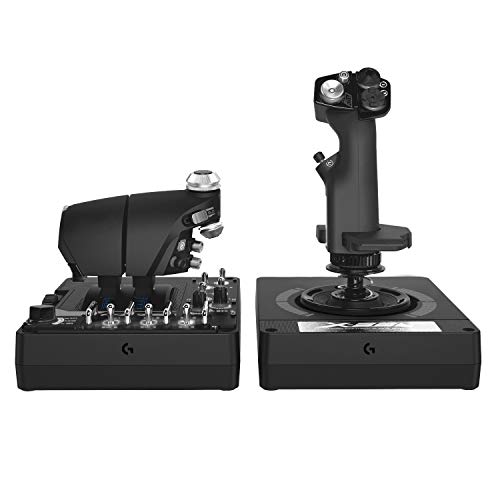
Logitech G X56 H.O.T.A.S Throttle and Joystick Flight Simulator Game Controller, 4 Spring Options, +189 Programmable Controls, RGB Lighting, 2x USB, PC - Black
Included for 'Best Flight Sticks for Gaming' because the listing specifies 4 Spring Options and +189 Programmable Controls, details this guide uses to compare options.
View on Amazon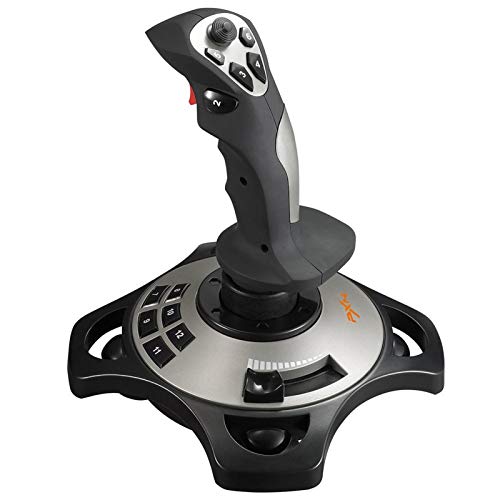
PXN 2113PRO PC Joystick USB Gaming Flight Simulator Controller Flight Stick
Included for 'Best Flight Sticks for Gaming' as a relevant option in this category; details come from the product listing.
View on AmazonPrecision depends on the gimbal, sensors, spring system, and software calibration. Hall-effect sensors avoid the physical contact used by older potentiometers, but they do not automatically make every stick equally accurate. A well-supported gimbal with adjustable springs and a stable center can feel considerably better than a stick with the same basic sensor technology.
Mounting also changes the experience. A lightweight stick on a high desk may slide during aggressive inputs, whereas a heavy metal base can be comfortable on a cockpit rail but excessive for casual play. Before buying, measure the usable area rather than only the desktop’s overall width.
Head-to-head: the strongest choices
VKB Gladiator NXT EVO: best overall PC flight stick
The Gladiator NXT EVO is the most balanced choice for PC players who want more than an entry-level joystick without immediately building a full cockpit. Its grip provides a trigger, several hats, thumb controls, and a twist axis, making it suitable for combat flight, space games, and general aviation. The base is broad enough for ordinary desk use, and its software and interchangeable spring options provide a useful upgrade path.
Its main limitation is platform focus: it is primarily a Windows PC product, so it is not the right pick for Xbox or PlayStation users. It also costs more than basic Thrustmaster models and may require calibration and software setup before it feels ideal. For a serious PC player, however, that setup is usually worthwhile.
Thrustmaster T.16000M FCS: best affordable starting point
The T.16000M FCS remains a sensible first stick because its main axes use non-contact magnetic sensing and its grip can be configured for left- or right-handed use. It is compact enough for a modest desk and can be paired with the TWCS throttle or TFRP rudder pedals as funds allow.
The control layout is less sophisticated than newer premium grips, and the twist mechanism is a likely wear point after extended use. It is best for newcomers, occasional players, and households where the stick must be stored after each session. Choose the stick alone if you already have a throttle or keyboard; choose the HOTAS bundle if you want a coordinated setup immediately.
Turtle Beach VelocityOne Flightstick: best for console access
The VelocityOne Flightstick is the clearest choice when Xbox compatibility is important. It includes a generous control set, adjustable lighting, and a layout designed to handle both aircraft and spacecraft. Its integrated controls reduce the need to reach for a keyboard, which is valuable in a living-room setup.
It is not as flexible an enthusiast platform as VKB, Virpil, or Winwing equipment. Its base is also better suited to a stable table or lap board than a thin pull-out keyboard tray. Check compatibility for the exact game and console before buying, because support can vary by title.
Virpil and Winwing: best upgrade paths
Virpil’s Constellation Alpha grips and Winwing’s Orion2 family are aimed at players who expect to add a throttle, collective, pedals, extension, or desk mount later. Their heavier construction and more configurable controls suit flight-simulation rooms, racing-style rigs, and dedicated cockpit furniture.
These systems make less sense if you play only occasionally or need to pack the equipment away every night. The total cost grows quickly once you add a throttle and mounting hardware, and the larger bases need a firm surface. They are strongest when purchased as part of a planned control layout rather than as an isolated impulse purchase.
Desk and room measurements that affect your choice
| Setup detail | Useful target | Practical implication |
|---|---|---|
| Clear desk width for stick plus throttle | At least 36 inches; 48 inches is more comfortable | Allows the controls to sit beside the keyboard instead of behind it |
| Clear depth for a desk-mounted setup | At least 20 inches | Leaves room for the base, wrist movement, and a monitor stand |
| Usable knee clearance under the desk | About 24 inches high and 24 inches wide per leg area | Prevents a clamp or side-mounted control from colliding with your thighs |
| Seated control height | Grip top roughly level with, or slightly below, the elbow | Reduces shoulder tension during long sessions |
| Dedicated cockpit footprint | Approximately 30 by 60 inches before monitor space | Fits in many 10-by-12-foot rooms, but leaves less space for a chair or storage |
| Clearance around a chair or cockpit | 24–30 inches behind the seat and at least 18 inches on one open side | Makes entry, exit, and cable access possible without moving furniture |
A dining table can work if it is approximately 28–30 inches high and has no obstructive apron. A desk with a pull-out keyboard tray is often a poor mounting location because the tray flexes under force. For a small apartment, use a lightweight stick that can be stored vertically and avoid permanent side clamps. In a 10-by-12-foot room, a foldable cockpit or desk-mounted controls generally preserve more usable floor space than a fixed simulator frame.
Choose by game genre
- Space combat: Prioritize twist yaw, a mini-stick, multiple hats, and easy thumb access. A VKB Gladiator NXT EVO is a strong single-stick choice; dual sticks can be considered later for six-axis control.
- Air combat: Choose a stick with a firm center, a comfortable trigger, and a separate throttle if your games demand frequent power changes. The VKB, Virpil, and Winwing ecosystems offer the best long-term expansion.
- Civilian flight simulation: A stick-and-throttle or yoke setup is usually more useful than a grip crowded with combat buttons. Consider adding rudder pedals before upgrading to an expensive grip.
- Helicopter simulation: Smooth low-force movement and the ability to add a collective are more important than a large button count. A modular enthusiast system is preferable if helicopters are your primary focus.
- Arcade flight games: The T.16000M or VelocityOne is usually sufficient. Spending on a metal cockpit is unlikely to improve a game designed around simplified controls.
Mounting, materials, and durability
Plastic bases are lighter and easier to move, but they need rubber feet and a stable surface. Metal bases resist sliding and generally feel more planted, although they add weight to a desk clamp or shelf. A heavy unit can also damage a thin laminated desktop if its clamp concentrates pressure in one small area; use a protective board beneath the clamp.
For renters, a removable clamp or a freestanding lap board avoids drilling holes. Permanent under-desk mounts create the cleanest cable arrangement but reduce flexibility when the desk is moved. Measure the desk’s underside before ordering: drawers, crossbars, and cable trays can block a clamp even when the top appears spacious.
The first parts likely to show wear are twist-axis mechanisms, trigger switches, rubberized grips, and USB cables that are repeatedly bent at the base. Keep the stick covered when not in use, avoid pulling it by the cable, and leave enough slack for normal movement. A replaceable spring or modular grip is a more meaningful upgrade path than decorative lighting.
Buying decision in one minute
- Small desk or shared room: T.16000M FCS or VelocityOne Flightstick, depending on platform.
- PC player wanting one excellent stick: VKB Gladiator NXT EVO.
- Xbox player: Turtle Beach VelocityOne Flightstick, subject to the game’s compatibility.
- Long-term simulator build: Virpil or Winwing controls with a planned mount and throttle.
- Keyboard-and-mouse hybrid player: Favor a compact base and a useful hat layout over maximum button count.
- Back or shoulder discomfort: Place the grip close to your body, keep the elbow supported, and use a lower side mount rather than reaching across a wide desk.
For most people, the VKB Gladiator NXT EVO offers the best combination of precision, control layout, desk stability, and future flexibility. Choose the T.16000M FCS when price and compact storage come first, the VelocityOne when Xbox support is essential, and Virpil or Winwing when the flight stick is becoming the foundation of a dedicated simulator station.