Key takeaways
- House set far back from the road: Choose 8–12-inch digits or larger, with broad strokes and strong contrast. If the house is more than 100 feet from the road, a second address marker near the entrance can be easier to see than oversized numbers at the door.
- Dark or shaded approach: Consider illuminated numbers or a nearby porch light aimed at the address. Avoid a bright fixture that washes out the digits or creates glare for drivers.
- Coastal or frequently wet location: Prefer corrosion-resistant metal and exterior-rated fasteners. Inspect seams and mounting points, where water can collect or dissimilar metals can corrode.
- Brick, stone, or stucco wall: Use masonry-compatible anchors and a drill bit suited to the substrate. A lightweight plaque may be easier to mount securely than individual heavy digits.
- Covered porch and natural palette: Exterior-finished wood can work well if the number is sheltered and you are prepared to renew the finish when it starts to dull or crack.
- Busy façade or patterned siding: Use a simple font and a contrasting backing plaque. Extra ornament can make the address harder to pick out at a glance.
Best Decorative House Numbers: Choose by Distance, Material, and Mounting
The best decorative house numbers are large enough to read from the street, high-contrast against their background, and mounted with hardware suited to the wall and local weather. Metal is a dependable all-round choice; ceramic adds color, wood suits protected entries, and illuminated numbers help where the approach is dark. Before choosing a style, check the viewing distance, available wall space, and how the numbers will be attached.
Start with visibility, not the finish
A number that looks delicate up close can disappear from a car or across a wide yard. Measure the distance from the likely viewing point to the mounting spot, then use the figures below as a practical starting point. Local rules may set a minimum character height, so check municipal requirements before ordering.
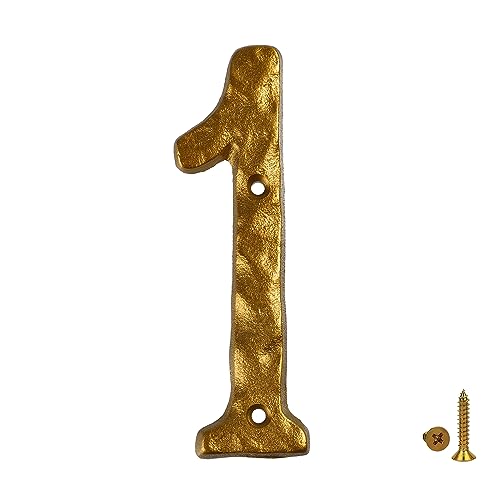
HILAZA House Number 1 for Outside, 5.5 Inch Cast Iron Metal Home House Address Numbers, Golden
Included for 'Best Decorative House Numbers for a Stylish Entryway' because the listing specifies 5.5 Inch Cast Iron Metal Home House Address Numbers and Golden, details this guide uses to compare options.
View on Amazon
Whitehall Personalized Cast Metal Address Plaque - USA Made Custom House Number Sign - Rectangle (11" x 6.25") - Black with Gold Numbers
Included for 'Best Decorative House Numbers for a Stylish Entryway' because the listing specifies USA Made Custom House Number Sign and Rectangle (11" x 6.25"), details this guide uses to compare options.
View on Amazon
Decorative Vintage Cast Iron Metal House Numbers 4.3Inch Rustic Hollowed Arabic Numbers 0 to 9 Cast Metal Address Number Home Garden Yard Mailbox Hanging Wall Sign Letters Decor (6 (4.3" Height))
Included for 'Best Decorative House Numbers for a Stylish Entryway' as a relevant option in this category; details come from the product listing.
View on Amazon
NACH House Numbers for Outside, 5.5 inch Black Address Numbers for House - Number 4 - Rustic Numbers for Outside with Mounting Hardware
Included for 'Best Decorative House Numbers for a Stylish Entryway' because the listing specifies 5.5 inch Black Address Numbers for House and Number 4, details this guide uses to compare options.
View on Amazon| Typical viewing distance | Suggested digit height | Good fit |
|---|---|---|
| Up to 20 ft | 4–6 in | Close sidewalk, compact porch, short driveway |
| 20–50 ft | 6–8 in | Street-facing wall or average front yard |
| 50–100 ft | 8–12 in | Long driveway or set-back house |
| More than 100 ft | 12 in or larger | Rural approach; consider a second sign near the road |
These are starting ranges, not guarantees: font shape, lighting, eyesight, and obstructions all affect readability. A narrow, thin-stroke “8” may be harder to spot than a broad one at the same height. For a multi-digit address, measure the full number as well as each digit. Four 6-inch digits with gaps can need roughly 22–28 inches of horizontal space, depending on the typeface and spacing.
Contrast matters just as much as size. Light digits stand out on a dark brick or painted wall; dark digits suit pale siding or stone. Avoid finishes that nearly match the background, and check the number in daylight and after dark. If plants, a storm door, or porch furniture could block the view, shift the mounting position rather than simply buying larger digits.
Material comparison: metal, ceramic, wood, or illuminated
| Type | Best for | Weather and upkeep | Mounting considerations |
|---|---|---|---|
| Metal: aluminum, stainless steel, or brass | Modern or traditional entries; crisp, durable lettering | Generally reliable outdoors. Aluminum is light; stainless steel resists corrosion; brass may develop a patina. Check the finish and hardware for coastal exposure. | Usually screws, studs, or a mounting template. Raised digits create a shadow and need adequate wall clearance. |
| Ceramic or porcelain | Colorful, handmade, Mediterranean, or cottage-style façades | Glazed surfaces handle rain well, but edges and unglazed backs can be vulnerable. Freeze-thaw conditions make outdoor-rated construction important. | Often installed as a plaque with screws or masonry anchors. A rigid, level backing helps prevent stress cracks. |
| Wood | Warm, rustic, or natural-looking entries | Needs a weather-rated finish and periodic inspection. End grain, joints, and exposed edges are common places for moisture damage to start. | Use exterior-rated screws and seal drilled holes. A covered porch extends service life, but does not eliminate upkeep. |
| Illuminated: backlit or internally lit | Dark streets, long approaches, or shaded entries | Check the outdoor rating, seals, and replaceable light source. Solar models depend on sun exposure; wired models need suitable electrical installation. | May require a power connection, mounting plate, or access to a battery or solar panel. Confirm the light can be seen without glare. |
For most exposed front walls, metal offers the simplest balance of legibility and low upkeep. Choose ceramic when the plaque’s color and character are part of the design, but verify it is intended for exterior and freeze-thaw use. Wood makes sense where a natural finish is worth maintaining. Illuminated numbers solve a visibility problem, but only if the power source and placement are practical.
Pick by the conditions at your entry
- House set far back from the road: Choose 8–12-inch digits or larger, with broad strokes and strong contrast. If the house is more than 100 feet from the road, a second address marker near the entrance can be easier to see than oversized numbers at the door.
- Dark or shaded approach: Consider illuminated numbers or a nearby porch light aimed at the address. Avoid a bright fixture that washes out the digits or creates glare for drivers.
- Coastal or frequently wet location: Prefer corrosion-resistant metal and exterior-rated fasteners. Inspect seams and mounting points, where water can collect or dissimilar metals can corrode.
- Brick, stone, or stucco wall: Use masonry-compatible anchors and a drill bit suited to the substrate. A lightweight plaque may be easier to mount securely than individual heavy digits.
- Covered porch and natural palette: Exterior-finished wood can work well if the number is sheltered and you are prepared to renew the finish when it starts to dull or crack.
- Busy façade or patterned siding: Use a simple font and a contrasting backing plaque. Extra ornament can make the address harder to pick out at a glance.
Mounting method: match the number to the wall
Individual digits, plaques, and illuminated signs attach differently. Before buying, check whether the package includes a template, screws, spacers, and anchors—and whether those fasteners are appropriate for your wall. Product hardware is often intended for a particular surface; it may not be suitable for masonry, hollow siding, or a rendered wall.
- Individual digits: Give a clean, custom look, but each digit needs accurate spacing and secure fixing. Use the supplied template or make a full-size paper layout before drilling.
- One-piece plaque: Keeps spacing aligned and can provide contrast on a busy wall. Its mounting points must sit on a stable, flat area.
- Raised or floating digits: Stand off the wall to create shadows. Confirm the supplied spacers leave enough clearance without making the digits wobble or catch on nearby trim.
- Adhesive mounting: Suitable only when the number’s instructions explicitly approve the surface and outdoor exposure. Rough masonry, dusty paint, temperature swings, and trapped moisture can undermine a bond.
When drilling, avoid hidden cables and pipes, and follow the manufacturer’s installation instructions. On siding, fasten into the appropriate structural backing rather than relying on a thin panel alone. Seal around penetrations where the wall system calls for it, but do not trap water behind a plaque.
Final checks before ordering
Measure the usable wall area, including nearby trim, lights, and door swings. Then check the total width of the address at the chosen digit height; the number needs room to breathe, but it should not be squeezed between architectural features. A simple paper mock-up taped in place is an easy way to judge scale from the street before making holes.
Finally, confirm that the finish and fixings suit the local climate, and that the number remains readable in both daylight and darkness. A well-chosen decorative address should complement the entry without making visitors work to find it: prioritize size and contrast first, then choose the material and style that fit the wall and the maintenance you are willing to do.