Key takeaways
- Pro: Pull-chain simplicity eliminates remote pairing and battery replacement
- Pro: Hunter’s Builder Plus line has a multi-year reliability track record
- Con: No light kit included; you need separate room lighting
What's inside
A ceiling fan is one of those home purchases that either disappears into the background or becomes a source of constant frustration. Wobbly blades, motors that hum after three months, remotes that lose their signal from across the room, and light kits that flicker—all of these are common complaints pulled from owner reviews across every brand we compared. The problem most buyers face is narrow: a handful of specs (blade span, motor type, mounting profile, control method) determine whether a fan will work in a given room, and beyond those hard requirements, long-term reliability separates the brands worth paying for from those you will replace within two seasons.
This roundup pulls together eight products from different price tiers and use cases, from budget flush-mount fans with integrated LED kits to a traditional pull-chain model from a legacy brand. We compared published specifications, current prices, and aggregated owner feedback to sort out which ceiling fan brands hold up and which ones cut corners in ways that matter after the first week of use.
As an Amazon Associate we earn from qualifying purchases at no extra cost to you. Product prices and availability are accurate as of the date shown and are subject to change.




Quick Picks
| Product | Best for | Price |
|---|---|---|
| Hunter Builder Plus (Pull Chain, New Bronze) | Traditional pull-chain reliability | n/a |
| Ohniyou 52-inch Low Profile | Smart-control value with lights | $59.99 |
| ZMISHIBO 52-inch Flush Mount | Low ceilings on a tight budget | $53.99 |
| Hunter Builder Plus (5 Blades, Brushed Nickel) | Quiet operation with a five-blade look | n/a |
| Hunter Builder Elite (No Light) | Pure airflow, no light kit | n/a |
| Zing Ear ZE-208s Replacement Switch | Repairing a broken pull chain | $6.99 |
| Depuley 42-Inch Modern | Small rooms and covered porches | $44.99 |
| Amazon Basics with LED Light | Simple plug-and-play from a known retailer | $53.08 |
How We Picked
We evaluated every product on four criteria: motor reliability as reported by owners over time, airflow efficiency relative to blade span and speed settings, build quality of the included controls (remote, app, or pull chain), and value—meaning whether the price reflects what you actually get in materials and performance. Brands with consistent complaints about early motor failure or remote disconnects were flagged regardless of sticker price.
The 8 Best Ceiling Fan Brands in 2026
Hunter Builder Plus (Pull Chain, 52-inch, New Bronze)
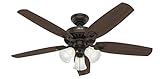
This is the entry point for buyers who want airflow without electronics to troubleshoot. A pull-chain control means nothing to pair, nothing to charge, and nothing to lose. Hunter’s Builder Plus line has a long track record, and owners frequently mention years of quiet service with minimal maintenance. The New Bronze finish suits traditional or transitional rooms. The trade-off is convenience: no remote, no dimming, no timer. Choose this if you want a fan you install once and forget about. Skip it if your room layout makes reaching the pull chain awkward or if you want integrated lighting.
- Pro: Pull-chain simplicity eliminates remote pairing and battery replacement
- Pro: Hunter’s Builder Plus line has a multi-year reliability track record
- Con: No light kit included; you need separate room lighting
Ohniyou 52-inch Low Profile with Lights (Remote/App, Black)
At $59.99, this fan bundles a five-speed motor, an integrated LED light kit, and dual control via remote and smartphone app into a low-profile housing that fits ceilings under eight feet. The value proposition is immediate: comparable features from established brands typically start at two to three times this price. Owners praise the app responsiveness and the brightness range of the LED. The main complaint centers on build quality of the remote and occasional pairing resets needed after router changes. If you want smart control on a budget, this is one of the best ceiling fan brands to consider at this tier. Skip it if you prefer physical wall switches or dislike app dependency.
- Pro: Remote and app control plus integrated lights under $60
- Pro: Low-profile design suits rooms with ceilings below eight feet
- Con: App connectivity can require occasional re-pairing
ZMISHIBO 52-inch Flush Mount with Lights (Remote/App)
Priced at $53.99, the ZMISHIBO occupies nearly the same feature space as the Ohniyou but at a slightly lower price. It offers remote and app control, a flush-mount housing for low ceilings, and an integrated light kit. Owners report adequate airflow on mid and high settings, though some note the low speed is barely perceptible. The black finish is neutral enough for modern bedrooms. The gap between this and the Ohniyou is small; the ZMISHIBO wins on price, the Ohniyou edges it on remote build quality and app polish. Skip it if you need strong airflow on the lowest setting for quiet nighttime use.
- Pro: Lowest price among app-controlled fans with lights in this roundup
- Pro: Flush-mount profile eliminates the gap between fan and ceiling
- Con: First speed setting provides minimal air movement
Hunter Builder Plus (5 Blades, 52-inch, Brushed Nickel)
The five-blade variant of the Builder Plus gives you the same reliable motor platform with a more contemporary look. Brushed nickel pairs well with modern kitchens and open-concept living areas. Owners consistently note the quieter operation compared to three-blade models at equivalent speeds, a difference attributed to the blade count distributing airflow more evenly. The trade-off is that five blades slightly reduce the maximum cubic feet per minute at the highest setting. If your priority is near-silent operation in a bedroom or nursery, this is a strong choice among the best ceiling fan brands at any price. Skip it if you need maximum airflow in a large, hot space.
- Pro: Five-blade design reduces audible turbulence at moderate speeds
- Pro: Brushed nickel finish matches modern hardware and fixtures
- Con: Marginally lower peak airflow than three-blade equivalents
Hunter Builder Elite (No Light, 52-inch, New Bronze)
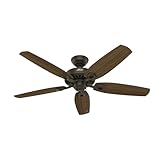
The Builder Elite strips things down to pure airflow. No light kit, no remote—just a motor, blades, and a pull chain. This is for rooms that already have adequate lighting or for buyers who want a fan that functions as a mechanical device, not an electronics platform. Hunter positions this as a step below the Builder Plus in price, and owners appreciate the simplicity of having fewer components to fail. The New Bronze finish keeps it visually consistent with the Plus model if you are matching fans across rooms. Skip it if you need integrated lighting or any form of remote control.
- Pro: Fewer components mean fewer things to break or replace
- Pro: Typically priced below the Builder Plus for equivalent airflow
- Con: No light kit, no remote, no timer or speed memory
Zing Ear ZE-208s 3-Speed Pull Chain Switch (Bronze Chain)
This is not a fan but a replacement pull-chain switch that can extend the life of any ceiling fan using a standard three-speed chain mechanism. At $6.99, it costs less than a single service call and eliminates the need to replace an otherwise functional fan whose chain switch has failed. The four pre-installed wires make it accessible for anyone who can use a wire nut. Owners report easy installation and a snug fit on most standard fan housings. The bronze chain matches darker finishes. Skip it if your fan uses a remote-only control system with no pull chain.
- Pro: Restores function to a working fan for under $7
- Pro: Pre-installed wires simplify a basic electrical swap
- Con: Only compatible with fans that use a standard pull-chain switch
Depuley 42-Inch Modern Ceiling Fan with Light (Black)
The Depuley targets a specific need: a fan for rooms too small for a 52-inch model or for covered outdoor spaces rated for damp locations. At $44.99, it packs six speeds, a dimmable light, remote control, a timer, and reversible blades into a 42-inch footprint. The flush-mount design keeps total height low. Owners in bedroom and small-office settings report solid airflow relative to the smaller blade span. The concern raised repeatedly is that the light module feels plasticky and the remote has a shorter range than larger models. Skip it if you need to cool a room larger than roughly 150 square feet.
- Pro: Rated for indoor and outdoor covered use in a small footprint
- Pro: Six speeds, dimmable light, timer, and remote under $45
- Con: Remote range is limited compared to full-size fans
Amazon Basics Ceiling Fan with LED Light and Remote (Black)
The Amazon Basics fan is straightforward: a 52-inch motor, LED light kit, and remote at $53.08. What buyers appreciate is the return policy and customer support that comes through Amazon if something arrives damaged or fails early. Owner feedback is mixed on long-term motor life—some report years of quiet service, others mention hum developing after several months of continuous use. The black finish is clean and modern. This is a reasonable pick if you want brand-name-adjacent features with low purchase risk. Skip it if you already own a ceiling fan you love and just need a replacement switch or if you need proven multi-year reliability.
- Pro: Retailer-backed return policy reduces purchase risk
- Pro: Integrated LED and remote at a mid-range price point
- Con: Owner reports of motor hum developing with extended use
Buying Guide
Blade Span and Room Size
Match blade diameter to floor area. A 42-inch fan suits rooms up to roughly 150 square feet; a 52-inch fan covers 150 to 350 square feet. Undersizing forces the motor to run at high speed constantly, shortening its life and increasing noise. Oversizing in a tight room creates a drafty, uncomfortable feel rather than gentle circulation.
Mounting Height and Profile
Standard fans hang 12 to 18 inches below the ceiling mount, requiring at least eight feet of clearance for safe blade-to-floor distance. Flush-mount fans sit within six inches of the ceiling, making them the correct choice for rooms with seven- or seven-and-a-half-foot ceilings. Using a standard downrod fan in a low-ceiling room is the most common installation mistake reported in owner reviews.
Control Method and Future-Proofing
Pull-chain switches are mechanically simple and last decades, but offer no dimming or timer. Remote controls add convenience but introduce a failure point (lost remotes, dead batteries, pairing resets). App-controlled fans add smartphone scheduling and smart-home integration but depend on Wi-Fi stability. Choose the method you will actually use daily rather than the one that sounds most modern.
Our Verdict
Top pick: The Hunter Builder Plus (5 Blades, Brushed Nickel) offers the best combination of quiet operation, proven motor reliability, and visual versatility among the best ceiling fan brands in this group. Budget pick: The Depuley 42-inch delivers six speeds, dimmable light, remote, timer, and damp-rating for under $45, an unusually dense feature set at that price. Condition-based alternative: If your ceiling is below eight feet and you want app control with integrated lighting, the Ohniyou at $59.99 is the strongest low-profile option here.
FAQ
Are cheap ceiling fan brands worth buying?
At the sub-$60 tier, build quality and motor longevity are the primary trade-offs versus established brands. Fans like the Ohniyou and ZMISHIBO deliver impressive features (app control, LED kits, remote dimming) for the money, but owner reports suggest the motors and electronics are less proven over five-plus years. If you plan to replace the fan within a couple of seasons, the savings are real; if you want a permanent fixture, spending more on a Hunter or comparable brand reduces long-term hassle.
How do I know if my fan is rated for outdoor use?
Look for a “damp rated” or “wet rated” designation in the product listing. Damp-rated fans handle covered porches and enclosed patios where moisture is present but direct rain is not. Wet-rated fans tolerate exposure to water. Never install a fan listed for indoor-only use in an uncovered outdoor space, as motor corrosion and blade warping will occur quickly.
What causes ceiling fan wobble, and can I fix it?
Wobble is almost always caused by an unbalanced blade or a loose mounting bracket. Most owners fix it by tightening all screws at the blade-iron joint and the downrod pin, then using a inexpensive balancing kit (a clip-on weight and adhesive pads) on the blade that rises highest during rotation. If wobble persists after balancing, the mounting box in the ceiling may not be rated for fan use, which is a safety issue requiring an electrician.
Do I need a special electrical box for a flush-mount fan?
Yes. A ceiling fan requires an outlet box specifically rated for fan support, typically marked “fan rated” or “new work — ceiling fan.” Standard light fixture boxes cannot handle the rotational forces a fan generates and may loosen over time, causing a dangerous sag or pull-out. If your existing box is not fan-rated, replace it before installation rather than relying on additional screws or braces.